
What Information Is Required on a Clothing Label?
One question we hear from buyers is: “What do I actually have to put on the label?” Here is the quick answer.
Label Information | What It Means | Is It Required? |
Fiber content | Fabric composition and percentages | Required in the US and EU for covered textile products |
Country of origin | Where the garment was made | Generally required in the US; not universally required under EU textile labeling rules |
Care instructions | Washing, drying, and ironing guidance | Generally required in the US; no uniform EU-wide requirement |
Manufacturer or business identification | Identifies the responsible business | US: Company name or RN required for covered textiles. EU: Depends on applicable product rules |
Size | Garment sizing information | Generally not required under core US/EU textile labeling rules |
Brand logo | Brand identity | Generally optional |
Fiber content must match the real fabric
This is one item you cannot afford to guess. Say your leggings label reads 80% nylon and 20% spandex. If the bulk fabric has a different composition, the label may need correcting.
Before printing labels, check the confirmed fabric composition against the label artwork. If the figures do not match, resolve the difference first. Finding an error now is much easier than relabeling 1,000 finished pieces.
Leave room for the required details
You may have a logo, tagline, and size mark planned for your neck label. But what happens when you add the required fiber and origin information?
A small label can quickly become crowded. Check the wording and layout before approving the artwork. You may need a separate care label rather than squeezing everything onto one piece.
Clothing Label Requirements in the US and EU
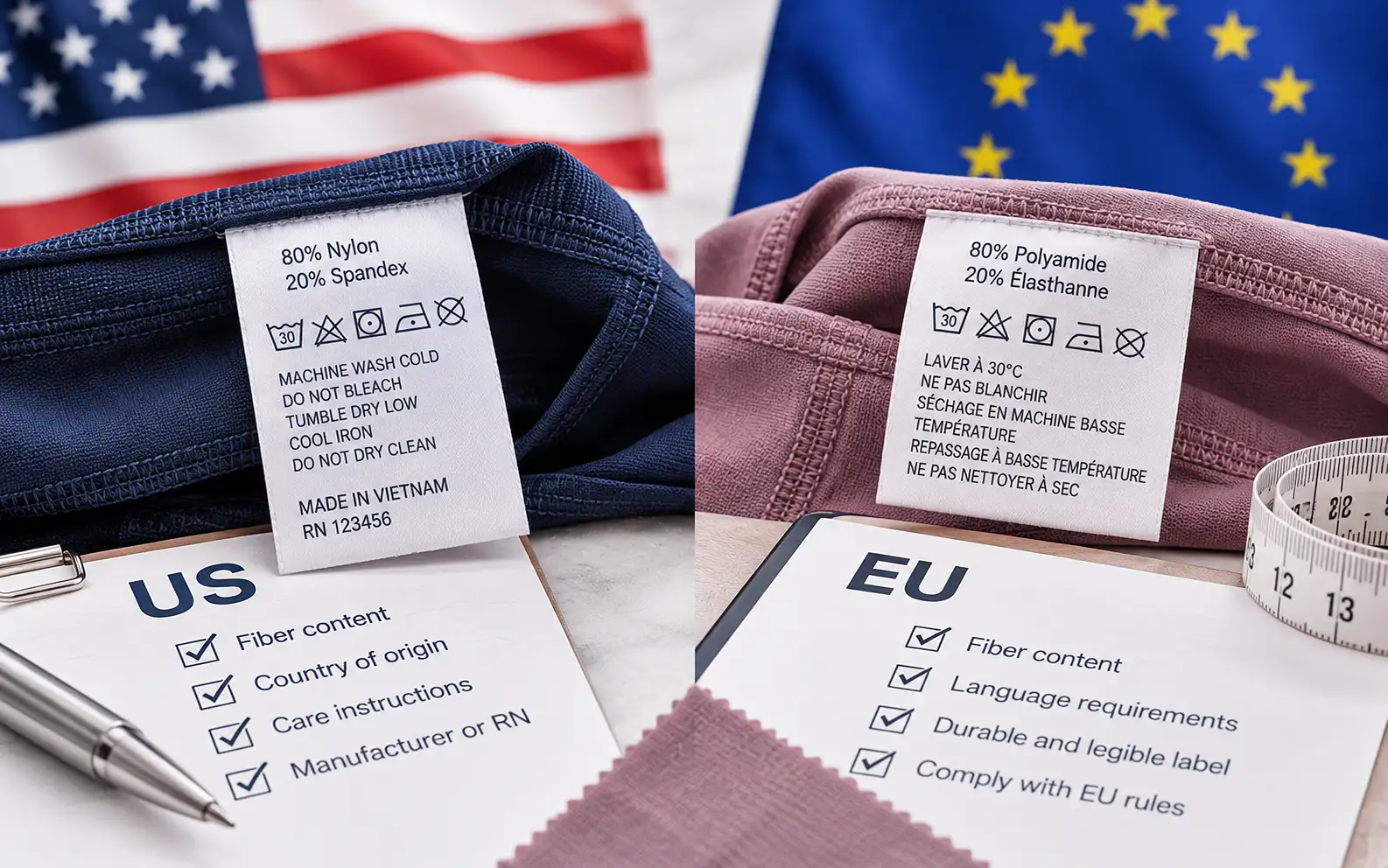
Both markets require fiber content on most clothing labels. After that, the rules split. We make labels for US and EU orders, so here is how we explain the differences to buyers.
United States Clothing Label Requirements
Most clothing sold in the US falls under the FTC’s Textile Fiber Rule (16 CFR Part 303). It requires three details: fiber content, country of origin, and the name of the manufacturer or another responsible business. You can use an FTC Registered Identification Number (RN) instead of the company name. Wool products have separate rules under 16 CFR Part 300.
Fibers are generally listed by weight, from highest to lowest. For example, 88% polyester and 12% spandex.
Care instructions follow the FTC Care Labeling Rule (16 CFR Part 423). The care label must be permanently attached and remain readable throughout the garment’s useful life. Consumers must be able to see the care information before purchase. If packaging or display hides the label, the care instructions must also appear on the packaging or a hangtag.
The FTC requires a reasonable basis for care instructions. Do not approve washing symbols or wording without supporting evidence.
Not every product follows the same rules. Wool, fur, and certain exempt items have special requirements, so check your product type first.
European Union Clothing Label Requirements
EU fiber labeling follows Regulation (EU) No 1007/2011. Labels must use approved fiber names and list each fiber percentage from highest to lowest.
Check Fiber Composition Before Label Approval
EU testing in 2026 found inaccurate fiber labels in 49 of 132 clothing samples. Sportswear had a 13% non-compliance rate. Before approving labels, check that:
Fabric specifications match the actual fiber composition.
Test results confirm the stated fiber names and percentages.
Final labels match the approved fabric details.
Language, Origin, and Care Information
Language: Clothing sold in France needs French fiber information. Check language rules for each target market.
Origin: EU Regulation 1007/2011 does not require origin information, but national rules may apply.
Care: Care instructions are not required under this regulation. Buyers can still include them for customers.
Product Identification and Manufacturer Details
The General Product Safety Regulation (EU) 2023/988 requires:
Product identification, such as a type, batch, or serial number.
Manufacturer name, postal address, and electronic address.
An EU-based responsible economic operator when the manufacturer is outside the EU.
A brand selling clothing under its own name or trademark may be treated as the legal manufacturer, even if another factory produces it.
Where Should Clothing Labels Be Placed?
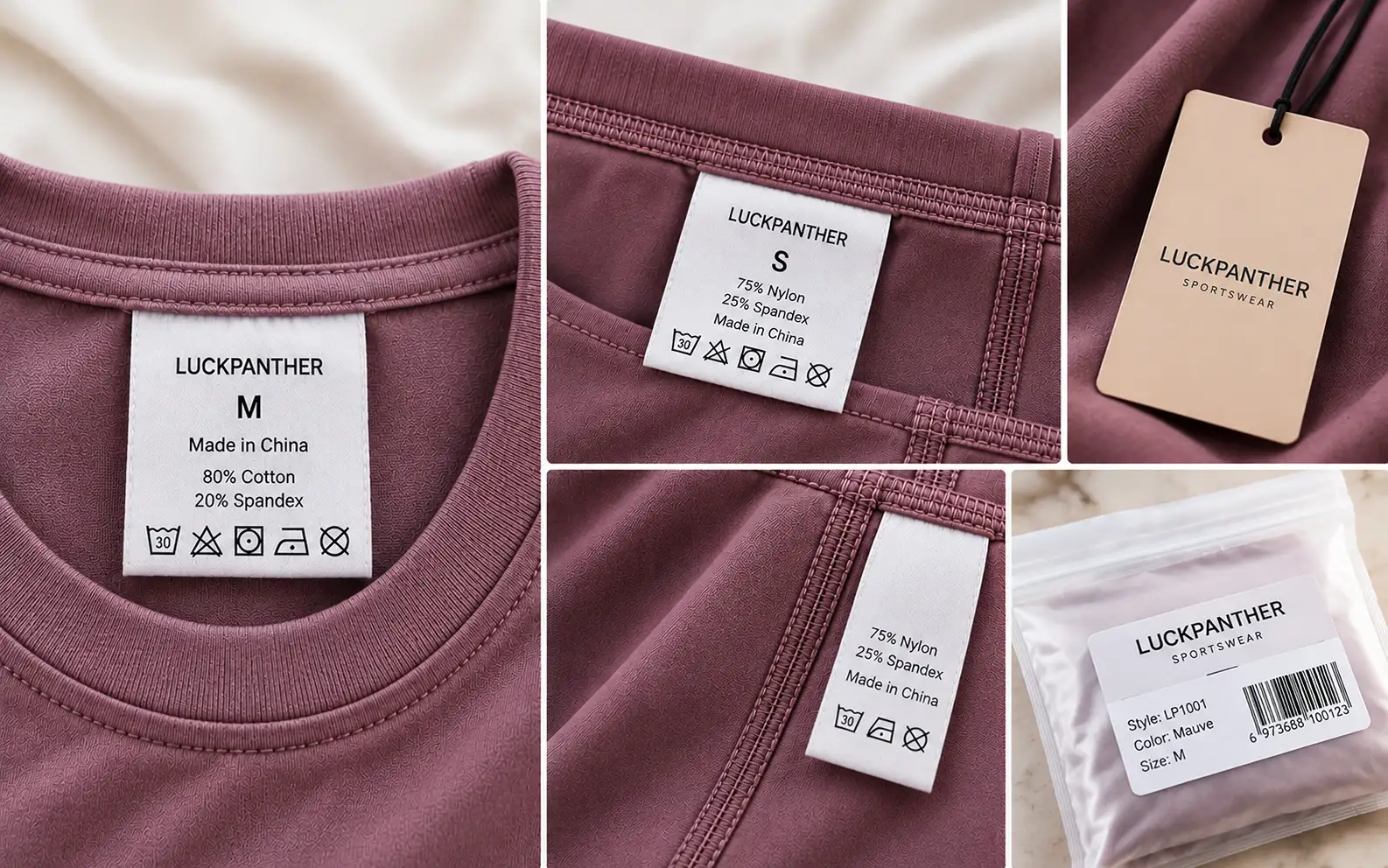
Can you put all the required information on a hangtag? Not always. A removable tag cannot replace a permanent care label on clothing covered by the US Care Labeling Rule. EU textile fiber labels must also be durable, legible, and securely attached.
For garments with a neck, US rules require the country of origin to appear on the inside center of the neck, either on a label there or immediately next to another label in that position. Other required details may have more flexible placement rules.
For custom leggings, the inside waistband or side seam is a common choice. The label should not rub against the skin or interfere with stretch. We check both placement and comfort when reviewing samples.
Hangtags and packaging can carry extra information, such as barcodes and product details. But check the applicable rules before using them instead of an attached label.