
What Is Clothing Product Development?
Clothing product development is the process of turning an initial garment idea into a tested, approved, and production-ready product. It typically includes concept definition, design feasibility, material selection, sampling, fit refinement, grading, testing, and final approval before bulk manufacturing begins.
Product development isn’t just “making a sample.” A sample is one output along the way — we typically run 3 to 6 per style (fit sample, fabric sample, pre-production sample), each checking something different. It’s also not bulk manufacturing. Manufacturing is the repeat-and-scale phase that happens after development locks in fit, fabric, and construction.
At LuckPanther, testing is part of development, not an afterthought. Stretch recovery, seam strength, and colorfastness get checked against standards like ASTM International’s textile testing methods before bulk starts.
The Clothing Product Development Process: 7 Key Steps

Now let’s break the process down into steps you can actually follow. Here’s what happens at each stage, and what we look for as a Chinese sportswear manufacturer.
1. Define the Product Concept
What exactly are you trying to develop?
Saying “leggings” or “sports bra” isn’t enough. You need to nail down:
- Intended use (yoga, running, weightlifting, daily wear)
- Target customer (age, body type, activity level)
- Fit (compression, relaxed, second-skin)
- Key functions (moisture-wicking, squat-proof opacity, four-way stretch)
- Product positioning (budget, mid-tier, premium)
Skip this step, and you’ll likely spec the wrong fabric weight or stretch ratio from day one. Then you pay for a full sample round just to find out. The Cotton Incorporated Lifestyle Monitor tracks how consumers shop differently for performance versus casual activewear. It’s a good gut check before you lock in positioning.
2. Check Design and Production Feasibility

Can the design actually be produced consistently? Not just once, but across 2,000 or 5,000 units, with the same quality every time.
This is where we look closely at:
- Construction (how panels are joined)
- Seam placement (does it sit where it’ll rub or chafe?)
- Bonding (heat-sealed seams for compression wear)
- Laser cutting (clean edges on technical fabrics)
- Pockets and trims (zippers, drawcords, waistband labels)
- Whether the design actually matches the fabric’s properties
3. Select and Test the Right Fabric
Two fabrics can both say “75% nylon / 25% spandex” on the label. That doesn’t mean they perform the same.
GSM, stretch percentage, recovery rate, knit structure, and finish can all be different, even with identical fiber composition.
Here’s a real trade-off we see often: switch a legging from a 220 GSM fabric to a 260 GSM fabric, and you’re not just adding weight. You’re also changing:
- Compression level
- Waist pressure
- Opacity
- Stretch percentage
- Overall fit
A higher-GSM version may improve coverage, but depending on the knit structure and elastane construction, it can also change stretch, recovery, compression, and waist pressure.
Our solution
Never confirm a fabric by fiber composition alone. During development, we verify weight (GSM), stretch percentage, recovery rate, and actual garment performance on a cut sample, not just a fabric swatch.
4. Develop the First Sample

What should you check on the first sample? Not “does it look right,” but three things: Fit, Construction, and Performance.
For a legging, that means:
- Fit: waist pressure, rise length, gusset placement
- Construction: seam placement, stitch density, panel alignment
- Performance: squat opacity, stretch recovery after wear
Common mistake: changing too many things in one sample round
Say the first sample has a waist that digs in and a rise that feels too short. Many clients ask for everything at once: new fabric, taller waistband, different rise, less compression.
The problem is simple. If sample 2 comes back better, you won’t know which change fixed it. Now if a future order needs adjusting, you’re guessing again.
Our solution
We change one variable at a time. Find the issue, isolate the likely cause, change that one thing, resample, and verify.
For example, if waist pressure is the complaint, we test a wider waistband first, keeping fabric and rise the same. Only if that fails do we check spandex percentage next. Styles handled this way usually land at 2 to 3 sample rounds instead of 4 or 5.
5. Lock the Base-Size Fit Before Grading
When is a sample actually ready for size grading? Only once the base size fit is fully locked, not before.
Common mistake: starting size grading before base-size approval
Say the M size waist is still 2cm too tight, the rise needs another 1cm, and the inseam isn’t confirmed. Some teams start grading XS through XXL anyway to save time.
The problem shows up later. If the M size waist changes again, every other size built off it needs rework too. A 2cm shift at the base size can mean 6 sizes get re-graded instead of 1.
Our solution
We follow a fixed order: approve base-size fit, lock the measurements, then start grading.
Base-size approval means waist, rise, inseam, and gusset placement all measure within tolerance (usually within 0.5cm) on the physical sample, not just on paper. Once that’s signed off, we grade using a consistent increment across sizes, commonly 5-6cm per step across the waist for leggings, following grade rule logic similar to what Alvanon publishes for fit and size chart development, then adjust to match the brand’s own chart.
Not sure if your size chart is graded correctly? Send it our way and we’ll take a quick look before you cut a single sample.
6. Revise and Approve the Final Sample

What’s left to check once fit and grading are both locked? The final sample review covers everything that hasn’t been tested yet: trims, labeling, colorfastness, and construction and fit across selected graded sizes.
What we check at this stage:
- Trims and hardware (zippers, drawcords, elastic bindings) hold up after 20+ open-close or stretch cycles
- Labels and care tags meet the brand’s compliance requirements for the target market
- Colorfastness after wash, checking for bleeding or fading, especially on darker dye lots
- Construction consistency across at least 2-3 sizes from the graded set, not just the M sample
We pull at least one size from each end of the range, typically XS and XL, for these final checks. A waistband can sit fine on M but roll on XS, since fabric recovery behaves differently at a smaller circumference.
For labeling and fiber content compliance, we check requirements against resources like the FTC’s Textile and Wool Act guidance, since a mislabeled fiber percentage can hold up a shipment at customs even after everything else is approved.
7. Lock the Approved Standard and Move to Bulk Production
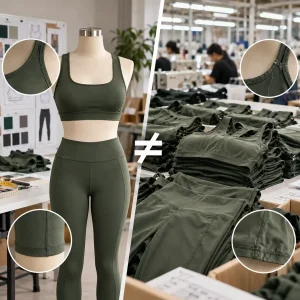
Once the final sample is approved, we lock the fabric, measurements, construction, trims, and color as the standard for bulk production. At this point, development should be finished. Bulk production is about repeating what was approved, not making new design changes.
Before cutting, we reconfirm the bulk fabric against the approved sample. This matters because a new dye lot can come back with a slightly different shade, stretch, or hand feel.
We also set measurement tolerances and use the approved sample as the QC reference. The first units off the production line are checked before full production continues. If the waistband, seam placement, or measurements are already drifting here, it’s much cheaper to correct 10 pieces than discover the same problem across 2,000.
Why Sportswear Product Development Is Different

Sportswear isn’t just apparel with a tighter fit.
Fabric ↔ Fit
Change the fabric, and the fit changes too, even with the same pattern. Switching from a 25% spandex fabric to an 18% option can change stretch and recovery enough that the same band pattern no longer fits as intended.
Fit ↔ Performance
A fit that looks right standing still can fail in motion. A running jacket sleeve can look perfect on a mannequin, then restrict shoulder movement by 15-20 degrees mid-stride if the armhole is cut too tight.
Construction ↔ Movement
Seam type decides whether it survives repeated motion. A flatlock seam on a legging inseam handles running or cycling without chafing. A raised overlock seam in a high-friction area can create more noticeable rubbing than a flatter seam construction.
What Should Be Finalized Before Bulk Production?
Before bulk starts, everything above should come together into one locked spec. Here’s the short version:
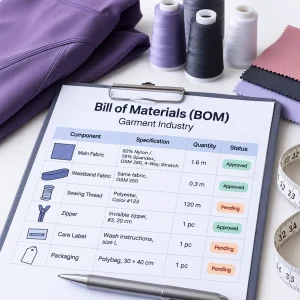
- Fabric: GSM, stretch, and recovery tested and signed off
- Fit: base size approved, full range graded from it
- Construction: seam types and trims confirmed at stress points
- Performance: opacity and stretch recovery verified under motion
- Production plan: fabric consumption, cutting ratio, and QC checkpoints scheduled
If any of these is still a guess, bulk production is starting on one too.
Want a manufacturer to check your spec before you commit to a bulk order? Talk to our team and we’ll flag any gaps before they turn into a re-cut.