
Why an Approved Sample Does Not Guarantee Bulk Quality
You approved the sample, so why can the bulk order still look different?
Bulk sportswear can vary because fabric lots, cutting conditions, sewing operators and machine settings change when production scales up.
- Fabric can change. Sampling yardage and bulk rolls may come from different production batches, so the bulk material still needs to be verified.
- More operators are involved. Small differences in stitch tension, seam allowance or elastic attachment can appear when production moves onto a full sewing line.
- Cutting scales up. Fabric is cut in multi-layer lays. Shifting, uneven fabric relaxation or cutting outside tolerance can affect many pieces at once.
- Production settings change. Needle replacement, thread adjustment or heat-press changes can affect the pieces that follow.
The approved sample sets the target. Quality control is what keeps these production variables from moving the bulk order away from it.
Turn the Approved Sample Into a Production Standard
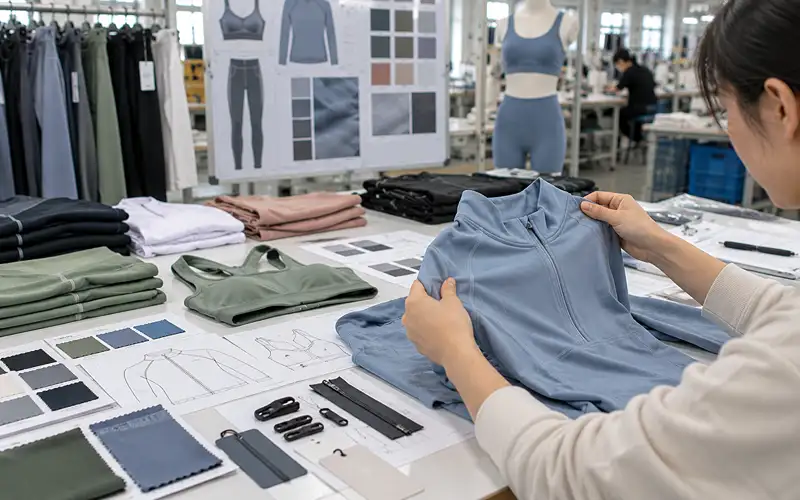
An approved sample should become the standard the production line works against, not just a visual reference.
Lock What Cannot Change
Once a sportswear sample is approved, its fabric, measurements, construction, trims, branding and finishing should be locked as the production standard.
- Fabric — code, composition and GSM. Any bulk fabric substitution should be flagged before cutting, especially when it changes the fiber content labeling of the finished product.
- Color — approved lab dip or physical swatch
- Measurements — base measurements and tolerances
- Construction — stitch type and seam allowance
- Elastic and trims — width, stretch and specified supplier
- Branding — logo size and placement
- Finishing — wash, heat-press or coating requirements
“Make it look like the sample” is not a production standard. A cutter cannot eyeball GSM, and a sewing operator cannot guess seam allowance from a photo. They need measurable specifications.
Keep One Approved Reference Sample
We keep the approved reference sample available during bulk production so QC can compare production pieces against it.
When something looks different, the bulk piece should be checked side by side with the reference sample and tech pack. Measurements, fabric, stitching or branding can then be checked against the locked specification instead of relying on memory or opinion.
Have an AI-generated spec, or reference sample? Send it to LuckPanther. We can review what is ready for sampling and what still needs to be confirmed before development starts.
Check Bulk Fabric Before Cutting Starts
This is the first real checkpoint where problems should get caught — before a single piece gets cut.
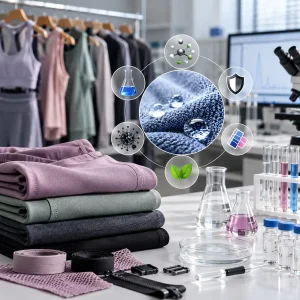
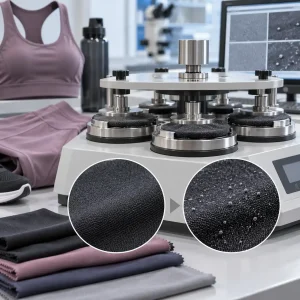
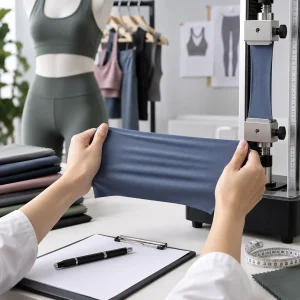
Before cutting, bulk sportswear fabric should be checked for shade, GSM, stretch, recovery and visible defects against the approved standard.
Check | What Can Go Wrong |
Shade | Rolls from different batches show visible color variation side by side |
GSM | Bulk fabric feels lighter or heavier than the approved sample |
Stretch | Leggings come out tighter or looser than expected |
Recovery | Fabric does not return close to its original shape after stretching |
Fabric defects | Holes, stains or knitting flaws slip into the cutting pile |
Before cutting starts, we re-check the key fabric properties on the bulk fabric itself — not the sample yardage, but the real rolls sitting in the warehouse. When comparing a China sportswear manufacturer, ask whether bulk fabric is rechecked against the approved sample before cutting.
This one extra step catches problems while they are still cheap to fix. A bad roll pulled before cutting is a phone call to the supplier. A bad roll caught after 500 pieces are already cut and sewn is a much bigger, more expensive conversation.
For dark colors, contrast panels, or styles where color transfer is a concern, complete the required color fastness testing before bulk cutting.
Catch Problems in the First Pieces, Not the Last 100
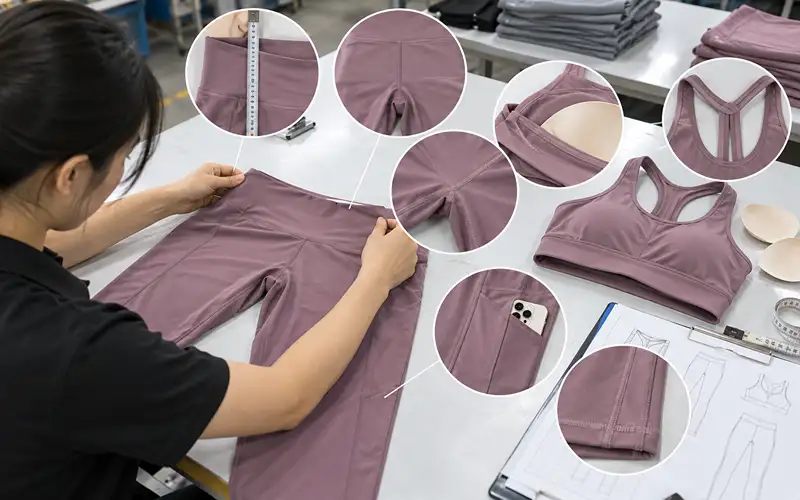
Final inspection is important, but buyers should also ask a more useful question: how early is the factory checking the bulk order?
Check the First Pieces Off the Line
We compare the first finished pieces against the approved sample before full production continues.
For leggings, we check waistband height, front and back rise, inseam, gusset position and seam appearance. For a sports bra, we check the underband, strap position, pad pocket and neckline symmetry. These are also useful checkpoints when evaluating a leggings manufacturer for bulk production.
If something is off, the machine or operation can be corrected and the next pieces checked again. A correction made early may take one adjustment. The same problem found much later can mean sorting or reworking part of the batch.
Watch for Repeating Defects During Sewing
One skipped stitch may be an isolated defect. The same skipped stitch appearing repeatedly in the same seam points to a production problem.
The main purpose of inline QC is to catch repeating production problems before the same defect spreads across the bulk order.
On the line, that might mean:
- The same seam puckering
- Waistbands repeatedly twist
- Logo placement starts drifting
- Elastic tension becomes uneven
Catching the pattern early means the cause can be corrected before more pieces are affected.
How Do You Know a QC Problem Is Actually Fixed?
A factory saying “we fixed it” does not tell you whether the affected pieces were found or whether the same problem appeared again.
When a production issue is reported, you should confirm three things:
- How many pieces may be affected? Ask when the problem started and which production batch was involved.
- Was the cause corrected? A repaired garment fixes one piece. It does not fix the machine, construction or material issue that caused it.
- Were new pieces checked after the correction? The next production pieces should confirm that the same defect is no longer repeating.
For a larger issue, ask for updated inspection photos, measurements or a short QC report before approving the correction.
The useful question is not “Did you fix the defect?” It is “How did you confirm the problem stopped?”
Want fewer quality surprises in your next bulk order? Get in touch with us to discuss the QC requirements for your product before production starts.
Final Inspection Should Confirm Quality, Not Discover It
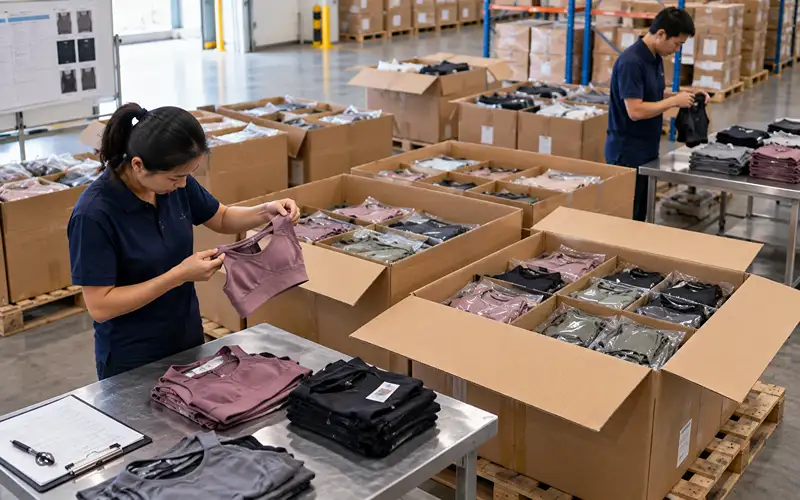
By the time an order reaches final inspection, the major production issues should already have been found and corrected.
Final inspection is there to verify the finished order, not to become the first serious quality check. At this stage, the inspector checks workmanship, measurements, quantity, appearance, packaging, and consistency across the finished goods.
If major defects first appear here, fixing them is usually harder because production is already complete.
For sample sizes, AQL levels, defect classification, and pass/fail limits, see our guide to apparel AQL inspections.