
1) Decide What You Need Before Contacting Chinese Suppliers
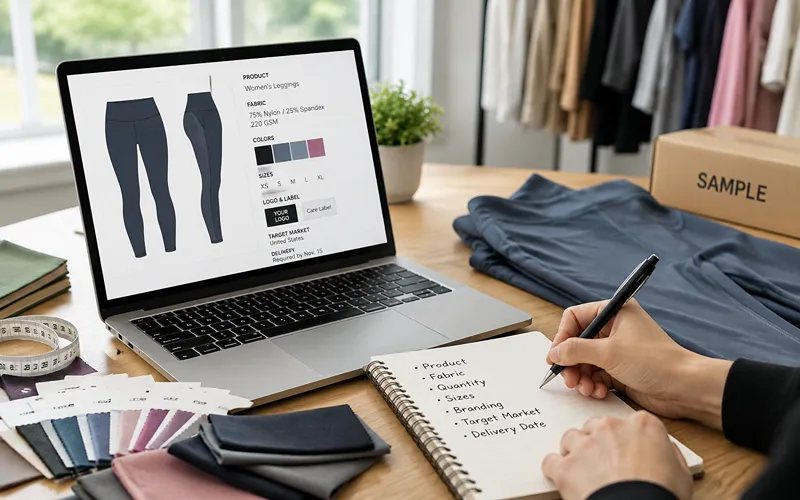
Before contacting a Chinese clothing supplier or sportswear manufacturer, define your product type, fabric composition and GSM, quantity per style and color, size range, printing or embroidery, private label requirements, target market, and required delivery date. These details help factories quote the same specification, so you can compare prices accurately.
For example, a basic RFQ might look like this:
Requirement | Example |
Product | |
Fabric | 75% nylon / 25% spandex, 220 GSM |
Quantity | 500 pcs |
Sizes | XS–XL |
Branding | Heat-transfer logo + custom label |
Target market | United States |
Delivery | Required by Nov. 15 |
In our factory, we often see buyers send one reference photo and ask, “How much for 500 pcs?” That is rarely enough for an accurate quote. A 220 GSM nylon-spandex legging will not cost the same as a 180 GSM polyester version. Logo method, labels, and packaging can change the price again. The more you confirm before the RFQ, the fewer assumptions the factory has to make. Still working out your product requirements? Tell us what you’re planning to make and your expected quantity. We can tell you which details need to be decided before sampling starts.
2) Find the Right Clothing Manufacturer in China
You’ve got specs. Now you need a supplier that can actually make them.
Alibaba, Made-in-China, Google, trade shows, and sourcing agents are common starting points. The platform matters less than whether the supplier fits your product and order size.
To choose a clothing manufacturer in China, check whether they regularly make your product category, accept your quantity, support OEM or private label, and can develop a sample from your specifications. You should also verify their business information before placing an order.
Manufacturer vs. Trading Company
A direct manufacturer gives you closer access to product development and production. A trading company works with one or more factories and can be useful for smaller orders or multiple product categories. Neither is automatically better — the right choice depends on your order.
For sportswear, instead of asking, “Can you make leggings?” ask whether the supplier can source your required GSM and stretch level and reproduce the waistband construction in your design. A China sportswear manufacturer that can explain the fabric, stretch, and construction is easier to evaluate than one that only says, “Yes, we can make it.”
3) Send an RFQ That Gets an Accurate Quote
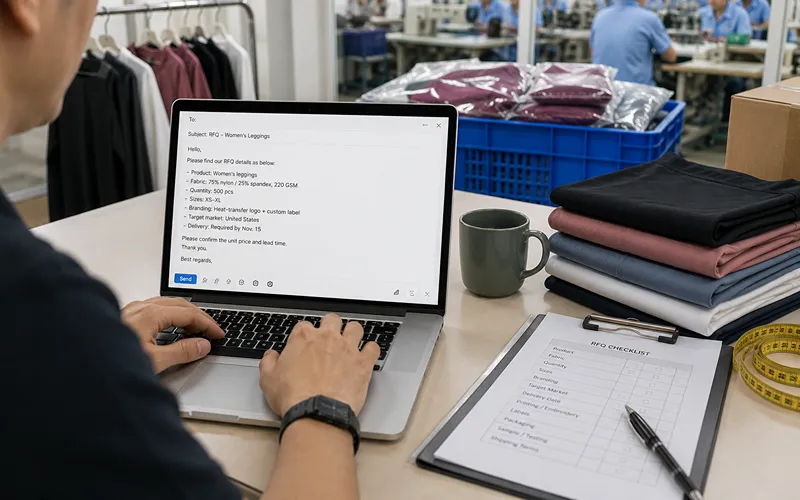
Send the same RFQ to every shortlisted factory so you’re comparing the same scope. A lower unit price may exclude costs that another supplier has already included.
For example:
- Factory A: $8.20/pc
- Factory B: $7.40/pc
Factory B looks cheaper. But the difference may come from fabric, labels, packaging, testing, or different shipping terms. Confirm what is included and what is charged separately:
- Labels and printing
- Packaging
- Sample or testing fees
- Freight
- Incoterm (FOB, EXW, etc.)
Two quotes with different inclusions aren’t really comparable. Match the specifications and terms first, then compare the price.
4) Order Samples Before You Place a Bulk Order
Order a sample before placing a bulk clothing order, especially for custom products. It lets you check the fabric, fit, construction, branding, and wash performance before committing to hundreds of pieces.
Check:
- Fabric, GSM, and color
- Measurements and fit
- Stitching and construction
- Logo and labels
- Wash performance
Sportswear sample cost varies by product complexity. Based on our current sampling rates, a standard yoga bra or legging sample starts at around $100, while a more complex sports jacket can reach $195–225. Extra fabrics, zippers, or special construction can push the cost higher.
Never approve a sample you wouldn’t accept in bulk. Once approved, it becomes the reference for production and QC, so any problems with fit, color, or construction should be fixed before bulk production starts.Testing your design before committing to bulk? Start with a sample and see how the fabric, fit, and construction work in an actual garment.
5) Confirm the Purchase Order Before Paying the Deposit
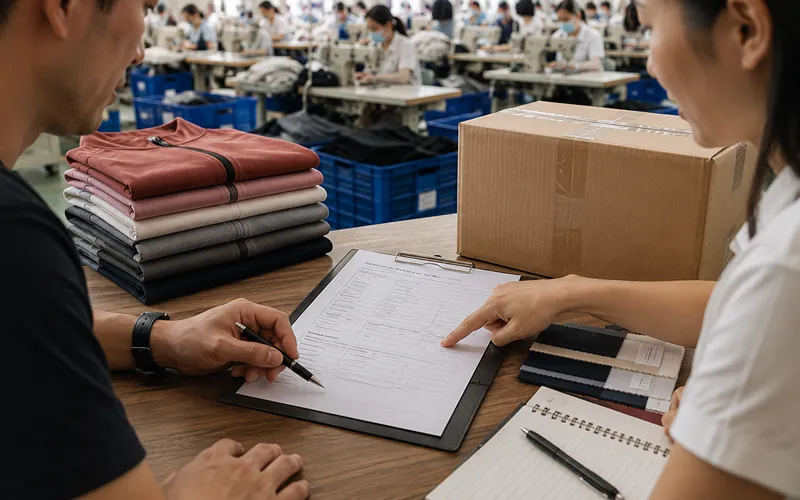
Before any deposit goes out, confirm every important detail in writing. This is where vague agreements can turn into expensive production mistakes.
Check that your PO includes:
- Final unit price
- Quantity
- Size and color breakdown
- Approved sample reference
- Fabric specification
- Labels and packaging
- Production lead time
- Payment terms
- Incoterm
- Defect or remake agreement
Here’s the principle to hold onto: anything important should be written into the PO or production specification, not left buried in WhatsApp or email conversations.
For example, “same fabric as the sample” leaves room for confusion. Record the approved fiber composition, GSM, color code, and sample reference so the production team has a specific standard to follow.
6) Inspect the Clothes Before Final Payment and Shipping
Quality control can happen at several stages, including during production and before shipment. For you as the buyer, the final inspection is one of the most important checkpoints — do it when production is complete, but before the goods leave the factory. Once the shipment is on its way to the port, fixing problems becomes much harder.
A final inspection should check:
- Quantity — does it match the PO?
- Measurements — against the approved sample and spec sheet
- Workmanship — seams, stitching, and trims
- Color — against the approved swatch, not “close enough”
- Printing or embroidery — placement and quality
- Labels — content, size, placement, and market requirements
- Packaging — folding, poly bags, cartons, and barcodes
Apparel inspections often use AQL (Acceptable Quality Limit) to determine the sample size and acceptable number of defects. The sampling procedures are standardized in ISO 2859-1. In apparel, AQL 2.5 for major defects and 4.0 for minor defects are commonly used, although the limits should be agreed before production.
Instead of checking every piece, the inspector samples the order using the agreed inspection level and AQL. If defects exceed the acceptance limit, the order may need rework or another inspection before shipment.
7) Calculate the Real Cost Before You Ship
The factory price is not your real cost. This is where a lot of margin can quietly disappear.
Use this formula to estimate your landed cost:
Landed Cost = Product Cost + Packaging + Freight + Insurance + Duty + Customs Fees + Local Delivery
Duty can catch buyers off guard. The rate depends on how your product is classified under the Harmonized Tariff Schedule. For U.S. imports, the importer of record is responsible for using reasonable care when classifying the goods, while U.S. Customs and Border Protection makes the final determination on classification and value.
Your shipping term also changes which costs and risks you handle. The ICC Incoterms® rules define these responsibilities between buyer and seller.
Term | What It Means for You |
EXW | You take on most costs and responsibilities from factory pickup |
FOB | Seller delivers the goods on board the vessel at the named port |
DDP | Seller handles delivery, import clearance, and duties to the named destination |
EXW may look cheaper because more costs sit outside the factory quote. DDP puts much more responsibility on the seller. FOB is commonly discussed for sea freight, but it is not suitable for every shipment — especially some containerized or multimodal arrangements.
Calculate the landed cost per garment before setting your retail or wholesale margin.
8) Prepare Customs and Import Documents
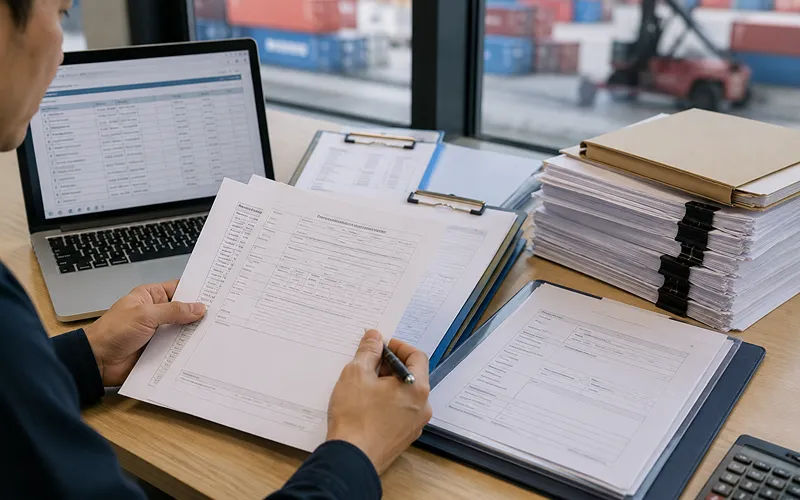
Paperwork and labeling requirements vary by destination, so confirm them before production and shipping.
Depending on the country and shipment, you may need or need to provide information for:
- Commercial invoice
- Packing list
- Bill of lading or air waybill
- HS classification
- Country-of-origin information
- Customs declaration
- Textile labeling and compliance documents
Product labeling is especially important because the rules change by market. In the EU, Regulation (EU) No 1007/2011 requires textile products to carry fibre composition information, with additional language requirements depending on where the product is sold. Check the official EU textile labelling requirements before production.
Confirm these requirements before care labels are printed and sewn into the garments. Fixing a label file is easy; replacing incorrect labels across a finished bulk order is not.
Is Importing Clothes from China Right for Your Brand?
Importing from China makes sense if you need custom fabrics, private labeling, specialized construction, scalable order quantities, or access to a broad apparel supply chain.
It may not be the best option if you only need a few dozen pieces, need stock immediately, or require little customization. In those cases, a local supplier or ready-made product may be faster and simpler.
Already comparing Chinese suppliers? Send LuckPanther the product you’re sourcing and your expected quantity. We’ll tell you whether it’s a project we can manufacture — and if it isn’t, we’ll say so.