
Why Sportswear Brands Choose Polyester

Polyester isn’t just popular by accident. It performs better for sports use. Here’s the science behind it.
The proof is in the sweat test.
A 2014 study from Western Michigan University tested how synthetic fabric handles heat and sweat during exercise. The results were clear:
- Runners wearing polyester-blend shirts stayed cooler than those in 100% cotton
- Polyester-blend shirts also retained less sweat
- Synthetic fabric dried in just 8 to 10 minutes. Cotton took over 45 minutes
We see this firsthand, every day.
At LuckPanther, we work with sportswear brands that need fabric to actually perform. Not just look good on a spec sheet. Polyester gives us that reliability, and here’s why we keep coming back to it:
- Shape retention. It holds its form, wash after wash.
- Color quality. It takes dye well, so colors stay bold instead of fading.
- Cost efficiency. It costs less than most performance alternatives. That matters when you’re hitting a price point without cutting corners.
This is also why so many brands work with sportswear manufacturers in China. Our supply chain gives us fast access to a wide range of polyester yarns and finishes. That means:
- Shorter lead times
- More room to test blends before a bulk order
- Easier scaling once you find the right fabric
Limitations of Polyester Fabric
Polyester has real strengths. But it’s not perfect. Being honest about the downsides helps you make a smart sourcing decision.
Breathability
Polyester is hydrophobic. It doesn’t absorb moisture like cotton does. That’s why it wicks sweat so well. But without the right knit structure, it can trap heat against the skin. This is a real issue for compress wear and other tight-fitting styles, where airflow matters most.
Our fix: we use mesh panels and open-knit structures in high-sweat zones. We test air permeability before bulk production.
Static & pilling
Polyester fibers are smooth and synthetic. They build up static charge easily, especially in dry weather. They also pill after repeated washing and friction. This is one of the top reasons buyers get return complaints.
Our fix: we adjust yarn twist and add anti-static or anti-pill finishes, depending on the garment. This matters a lot for custom dresses, where fabric hand and drape need to stay smooth after wash.
Microplastic shedding
This one gets talked about less, but it matters. Every wash releases tiny plastic fibers. Research published in ACS Omega found that polyester fabric shed around 87 microfibers per liter of wash water, while polyester fleece shed nearly 100 times more.
Our fix: we use tighter knit constructions. We also offer recycled polyester (rPET) for brands that want a lower footprint without giving up performance.
Why this matters when you’re sourcing
As a China leggings manufacturer, we see these issues come up constantly with tight-fit, high-performance styles. Leggings and compression garments sit close to the skin. Breathability and pilling resistance aren’t nice-to-haves. They’re deal-breakers for repeat customers.
If you’re working through fabric issues on your own line, reach out and we’ll walk through it with you.
Bottom line: polyester’s limitations aren’t reasons to avoid it. They’re reasons to work with a manufacturer who knows how to engineer around them.
Polyester vs Other Sportswear Fabrics

Polyester isn’t the only option. It’s one tool in a bigger toolbox. Here’s how it stacks up against the fabrics we get asked about most, side by side.
Property | Polyester | Nylon | Cotton | Modal |
Moisture handling | Repels water, wicks sweat fast | Absorbs some moisture, feels softer | Absorbs heavily, stays wet | Absorbs moisture, breathable |
Dry time | Fast | Slower than polyester | Over 45 minutes | Slow |
Stretch (blended) | 40–100% with spandex | Higher stretch and recovery than polyester | Low, unless blended | Low, unless blended |
UV resistance | Holds color and structure under sun exposure | Tends to yellow and weaken over time | Fades faster | Not built for outdoor use |
Cost | Lowest of the group | Higher, since raw materials cost more to produce | Mid-range | Mid to high |
Best use case | Running tops, shorts, outdoor training gear | Leggings, compression gear, swimwear | Casual wear, not performance gear | Loungewear, soft-hand athleisure |
A few things worth calling out:
- Nylon costs more because its raw materials, petroleum and natural gas, are pricier to process than what goes into polyester. That’s the main reason polyester stays the budget-friendly default for high-volume orders.
- Cotton just doesn’t compete here. In lab testing, cotton shirts took over 45 minutes to dry, compared to 8 to 10 minutes for synthetic fabric. For anything performance-related, that’s disqualifying.
- Modal fabric is soft and breathable, but it’s not built for sweat management. We usually blend it with polyester when a client wants that soft hand feel without losing polyester’s core fabric advantages, like quick-dry and shape retention.
What we tell our clients
There’s no single “best” fabric. The right choice depends on the garment and how hard it’s going to work. At LuckPanther, we walk clients through this decision every week. Sports bras, running shirts, and loungewear all have different needs, even though they might sit next to each other on a rack.
How to Choose the Right Polyester Fabric for Your Sportswear Collection
Picking a fabric isn’t just about polyester versus something else. It’s about picking the right polyester for the job. Here’s how we walk clients through it.
Start with GSM (fabric weight)
GSM stands for grams per square meter. It tells you how heavy or light a fabric is. The right GSM depends on what the garment needs to do.
Product type | Typical GSM range | Why |
Running tees, tanks | 160–200 GSM | Lightweight, breathable, fast-drying |
Leggings, sports bras | 180–240 GSM | Needs structure and opacity, not just softness |
150–190 GSM | Balance of durability and airflow | |
Cold-weather layers | 240–300+ GSM | Needs warmth and shape retention |
Our advice: don’t default to one GSM across your whole line. We’ve seen brands use the same 180 GSM fabric for running tees and leggings, then wonder why the leggings look sheer under stretch. Match the weight to the job.
Match the finish to the activity
Not every style needs the same treatment. A few finishes we use often:
- Moisture-wicking finish — for running, training, high-sweat gear
- Four-way stretch — for leggings, compression wear, anything form-fitting
- UV-protective coating — for outdoor gear like hiking or golf apparel
- Anti-pill treatment — for anything that’ll see heavy wash cycles
Don’t ignore new fabric technologies
The fabric market moves fast. Recycled polyester (rPET), cooling finishes, and bio-based coatings are becoming standard requests, not niche ones. We keep testing new fabric technologies in our own lab, so we can tell clients what’s actually ready for production, and what’s still more marketing than performance.
Ask your supplier these questions
Before you commit to a fabric, get clear answers on:
- What’s the exact GSM and blend ratio?
- What’s the shrinkage rate after washing?
- Is there a colorfastness test result you can share?
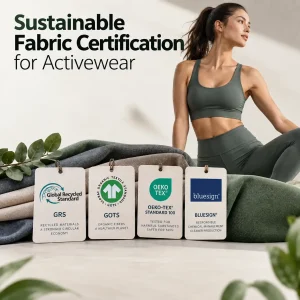
- Is any sustainability claim backed by a real certification, like GRS?
What we do differently
At LuckPanther, we don’t just hand clients a swatch card and call it done. We help match fabric to garment type based on how it’ll actually be worn and washed. That’s the difference between picking from a list of the best sportswear fabrics on paper, and picking the one that actually performs for your product. Send us your product specs and we’ll help you find the right fit.