
Introduction: Running Leggings Enter a New Era
Running leggings are no longer just a subcategory of tights. As performance activewear continues to evolve, running-specific leggings are emerging as a distinct, premium category—driven by demand for lightweight, technical, and stylish bottoms optimized for high-motion activity. While yoga leggings, compression tights, and general workout leggings remain staples, running leggings now occupy their own niche defined by their fabric technologies, design features, and hybrid usage from track to daily wear.
In 2025–2026, running leggings will stand out by blending material innovation, sustainable fabrics, and fashion-forward design. Brands and OEM/ODM manufacturers who lead in that integration will define the next generation of high-performance bottoms.
1. Running Leggings vs. Other Sports Tight Pants: Key Differences
To understand where the trends go, it helps to clarify how running leggings differ from other athletic tightwear categories:
| Feature Dimension | Running Leggings | Yoga / Training Leggings / Compression Tights |
| Core focus | Motion efficiency, sweat management, abrasion resistance | Flexibility, comfort, support, muscle recovery |
| Fabric demands | Very lightweight, fast moisture-wicking, wind resistance, durable through stretch cycles | Softer hand feel, higher stretch, medium durability |
| Design elements | Reflective details, zippered pockets, paneling for ventilation, wind panels | Minimal seams, wide waistbands, compression zones |
| Use-case transitions | Built to shift from outdoor runs to errands or casual wear | Primarily studio / gym / recovery usage |
| Fit strategy | Slightly compression but with freedom for stride; integrated technical panels | Smoother compression, often uniform across legs |
Because running imposes repeated stretches, friction, and dynamic motion, running leggings demand advanced performance fabrics, strategic paneling, and careful seam design to maintain shape and durability over time.
2. Material Innovation: The Engine Driving Performance

In 2025–2026, the most compelling advances in running leggings will be anchored in smarter fabrics and engineering. Below are several leading directions:
2.1 Quick-Dry & Moisture Management
Lightweight polyester blends with advanced wicking fibers are increasingly nuanced. Fabrics now integrate gradient deniers, capillary microstructures, and hydrophilic fiber treatments to accelerate sweat transport. Some brands are also introducing dual-denier layering (thin face, more absorbent inner) for optimized drying speed without bulk.
A trend report from Wunderlabel asserts: “In 2025, activewear will be high-tech, with brands using smart fabrics featuring moisture-wicking, temperature regulation, and even embedded sensor capabilities.”
2.2 Wind Resistance & Adaptive Shielding
Outdoor runners contend with headwinds. Thus, running leggings increasingly integrate wind-block panels—often laser-cut or semi-permeable—on front-of-leg or knee zones. The goal: block cold air while preserving ventilation. Some fabrics now offer directional wind resistance—rejecting air flow outward but allowing internal vapor release.
2.3 Ultra-Lightweight Constructions
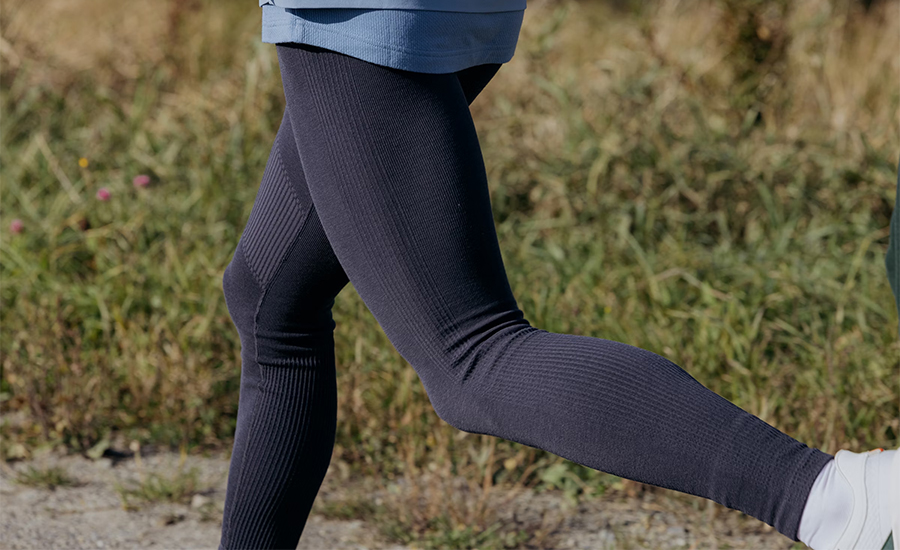
The push toward minimal weight leads to ultrafine yarns, micro-denier blends, and seamless knit constructions reducing interstitial bulk. Fabrics with four-way stretch but extremely low grams per square metre allow leggings to “disappear” on the skin, yet retain shape through multiple wash cycles.
2.4 Compression Mapping & Targeted Support
Rather than uniform compression, running leggings are adopting zoned or gradient compression panels—lighter compression on hamstrings, stronger support around knees, and stabilizing zones near hips. This selective compression aids muscle feedback and reduces fatigue.
2.5 Smart / Sensor-Integrated Textiles
A nascent but growing direction is embedding micro-sensors or conductive fibers into leggings to monitor strain, temperature, or movement. While still premium/experimental, this capability begins to appear in concept activewear lines. The trend toward “smart activewear” is gaining mentions in materials forecasts.
3. Sustainable Fabrics: Recycled & Eco-Friendly Materials
Sustainability is no longer optional—it’s becoming a baseline expectation. In the running leggings domain, several fabric strategies are rising:
3.1 RPET & Recycled Polyester
RPET (recycled PET from plastic bottles) remains a go-to choice. Its usage in activewear continues to scale: Textile Exchange’s “2025 Recycled Polyester Challenge” shows many signatories pushing above 45% recycled content in product lines.
3.2 Recycled Nylon / ECONYL®
Recycled nylon (often derived from fishing nets and industrial waste) is gaining traction because of its strong mechanical properties. It’s well-suited to high-stress zones (knees, seat) and pairs with compression yarns for durability without virgin input.
3.3 Circular & Regenerative Fiber Models
Efforts to close the loop are intensifying. BCG reports that 80% of discarded clothing ends up in landfill or incineration; only ≈12% is reused, and less than 1% becomes new fiber.
Better textile recycling, improved sorting (e.g. NIST’s fabric fingerprinting database), and fiber-to-fiber recycling innovations are under development.
3.4 Certification & Transparency
Brands and manufacturers are adopting GRS, OEKO-TEX®, Bluesign® to signal credible sustainability. Transparent origin documentation becomes part of marketing.
Thus, running leggings in 2025–26 will often offer “recycled performance” — combining high technical standards with lower environmental footprint.
4. Where Function Meets Fashion: Design Directions
A successful running legging in 2026 must not just perform—it must also look modern and wearable. Key fusions:
4.1 Color & Print Trends
Brands are shifting from plain neutrals to rich earth tones (mocha, camel, greige) and statement pops (fire-engine red revived) — a shift echoed in broader activewear color forecasts. Athleisure Mag™ | Athleisure Culture
Also observed is the return of subtle patterns—space-dye, tonal camo, micro-geometric textures—rather than bold graphics.
4.2 Reflective & Night-Run Elements
Reflective piping, engineered micro-reflective yarns, and modular safety attachments are integrated seamlessly into leggings so wearers gain visibility without aesthetics feeling “sporty gear.”
4.3 Paneling, Cutouts & Seam Detailing
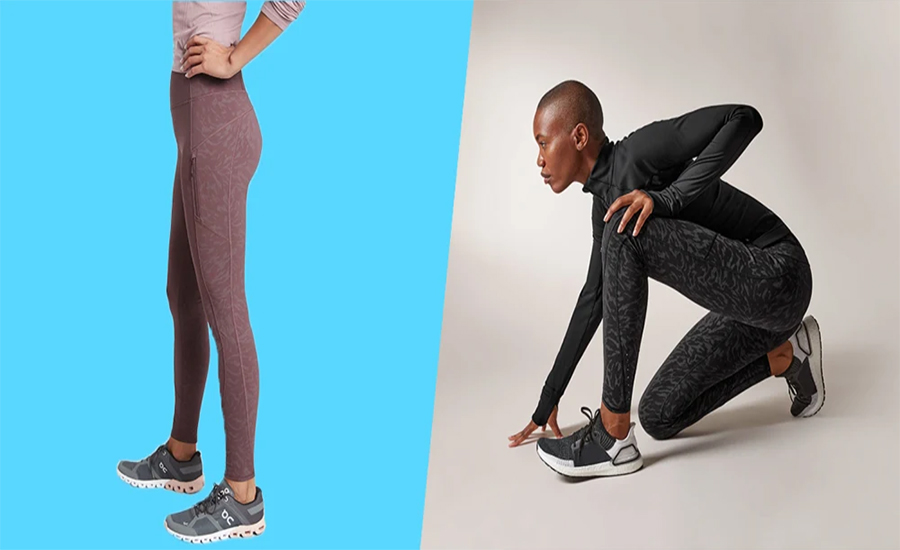
Expect asymmetric paneling, articulated seams, and engineered vents—especially in behind-knee, calf, and hip zones. Some leggings combine cutouts or mesh insets for visual interest and better airflow.
4.4 Multi-Scene Styling
Running leggings must feel equally comfortable during post-run errands or casual coffee runs. Thus we see subtle flare hems, cropped lengths, and flare-to-straight hybrids that can pair with streetwear. This aligns with the “function meets fashion” narrative seen in broader legging trend coverage.
5. Consumer & Market Insights Driving Demand
A trend is only as strong as market demand. What’s shifting beneath the surface?
5.1 Growth in Running & Active Participation
More people are running, training, and embracing wellness, fueling demand for technical bottoms.
Publications like Self highlight popular picks in running leggings across budgets and performance levels. SELF
5.2 Demand for Versatility & Value
Consumers expect leggings to serve multiple roles—training, recovery, daily wear. Many prefer investing in one well-performing pair rather than multiple niche ones.
5.3 Ethical & Transparent Supply Chain Expectations
Buyers increasingly look for origin transparency, “eco-performance” claims backed by certifications, and low-impact manufacturing footprints.
5.4 Fit Inclusivity & Size Range Expansion
Demand is growing for plus-size, tall, and gender-inclusive fits. Leggings lines that fail to offer inclusive sizing may lose competitiveness.
6. Future Forecast: What’s Next for Running Leggings
6.1 AI & Digital Sampling in Product Development
We’ll see 3D simulation, AI-assisted fit grading, and virtual prototyping reduce sampling cycles and waste.
6.2 Modular & Hybrid Designs
Interchangeable panels or modular add-ons (e.g. wind-flap skirts, detachable vents) will give users seasonal flexibility.
6.3 Biodegradable & Next-Gen Fibers
New biosynthetic fibers (e.g. algae-based, mycelium-derived) will enter pilot production.
6.4 Sensor Integration & Performance Feedback
Embedded sensors or conductive yarns may become more common in premium tiers, providing real-time data on muscle stress, stride symmetry, and thermoregulation.
6.5 On-Demand & Localized Production
Smaller regional micro-factories reduce lead time and carbon footprint, servicing next-gen brands that prioritize agility.
Conclusion & Call for Collaboration
The future of running leggings is not just about technical specs—it’s about uniting performance, sustainability, and style. For brands aiming to stay competitive in 2025–2026, success lies in integrating quick-dry fabrics, eco-conscious materials, and fashion-forward designs into collections that resonate with active consumers.
As an experienced OEM/ODM sportswear manufacturer, we bring deep expertise in developing custom running leggings—from sustainable fabrics to technical construction and stylish aesthetics.
Contact us today for sample kits, design consultation, and trend-aligned production solutions. Let’s shape the next generation of performance bottoms—together.