
What Is Size Grading in Sportswear?

Size grading means scaling a pattern up or down. It creates a full size range, from XS to XXL. The fit should stay the same at every size.
Sounds simple? It’s not.
Sportswear fabric stretches. A basic tee can grade in fixed steps, like 1 inch per size at the chest. But standards like ASTM D5585 lay out body measurement tables built for adult sizing. Those numbers were made for woven fabric that doesn’t stretch. Leggings, sports bras, and 4-way stretch tops are different. They don’t follow the same math.
At LuckPanther, we grade around your fabric and target fit. Contact us to discuss your custom sportswear sizing needs.
Mistake #1: Grading Before the Base Size Fit Is Approved
This is the mistake we see most often, even from good factories.
A factory grades all sizes right away, before the base size (usually M) gets fit-tested and approved. Then the buyer asks for a fix — maybe the rise is too low. The base pattern gets fixed. But nobody re-grades the other sizes.
The result:
- M fits great
- S and L still use the old pattern
- Your size chart looks right, but the garments don’t match it
In the apparel industry, a fit sample comes after the first proto sample and is tested on a live model to check real fit.
How we handle it: We lock the base pattern first. If a buyer changes the fit sample, we re-grade every size, not just one.
If you’re working with a China sportswear manufacturer, ask who updates the graded sizes after a fit correction. Don’t assume changing the base pattern automatically updates the full size range.
Ask your factory: “If I change my fit sample, do all sizes get re-graded too?”
Mistake #2: Using the Same Grade Increment Everywhere
We’ve caught this one on our own floor before.
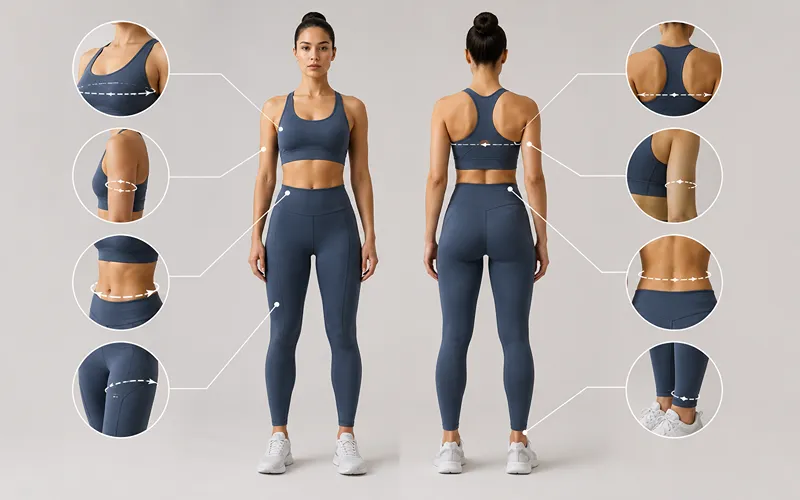
The mistake: one grade rule (say, 1 inch) applied to every point — chest, waist, hip, sleeve, all the same.
But bodies don’t scale that way, and neither do different types of sportswear. Chest and hip usually need bigger jumps. Shoulders and sleeves need smaller ones. A legging waistband may need a completely different increment than the hem.
This is why proper grading uses separate, graduated amounts at each pattern point instead of one flat number — a method documented in official U.S. Patent and Trademark Office filings on apparel sizing.
Real example: on our leggings, the waist grades 0.75 inches per size. The inseam only moves 0.25 inches. One flat number for both would stretch the smallest and largest sizes out of shape.This extra pattern and fit work is also one reason leggings manufacturing cost can change when the customer needs a wider size range or more complex fit requirements.
What we do: every grade rule table has separate increments for at least 6-8 measurement points, not one flat number.
Ask your factory: “Can I see the grade rule table by measurement point?”
Mistake #3: Ignoring Fabric Stretch and Recovery
Two fabrics labeled “4-way stretch” can behave very differently once grading is involved.
Stretch and recovery are two different numbers. Stretch is how far fabric extends under load. Recovery is how much it bounces back. A fabric can stretch 40% but only recover 90% — leaving 10% permanent growth over time.
We learned this the hard way. A buyer’s spec listed stretch % only, no recovery %. We graded around stretch alone. After one wash, mid sizes ran loose at the waist.
Now we check three numbers before grading:
- Stretch % (how far it extends)
- Recovery % (how much comes back)
- Growth % after wash or wear — the one buyers usually forget to ask for
Our rule: anything under 90% recovery gets tighter ease built into the grade, especially at the waistband and knee.
Ask your supplier: “What’s the recovery %, not just the stretch %?”
Mistake #4: Grading Leggings, Sports Bras and Tops the Same Way
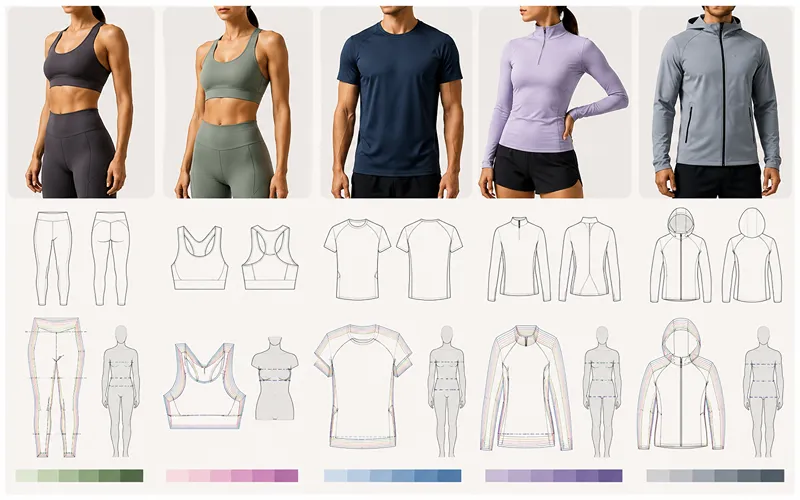
A tee, a legging, and a sports bra are not the same grading problem. Some factories run them through the same rule table anyway.
Why this fails:
- Leggings use negative ease. Built smaller than the body so fabric stretches to hold compression. Grade the waist like a woven pant, and compression disappears by size L.
- Sports bras often use zoned compression, not one stretch level. Compression garment patents show high-compression zones built for roughly 6.5-18.1 mmHg, with nearby zones as low as 1.6-6.0 mmHg. One flat grading rule flattens those zones.
- Tops in stretch knit still need positive ease at the armhole. Apply legging logic here, and the armhole runs too tight.
A mistake we’ve fixed before: we once applied one grading logic across a matching legging-and-bra set. The bra’s zoned support flattened out at size XL — it stopped compressing where it needed to.
Developing a multi-style activewear collection? LuckPanther can help you keep fit consistent across the range. Talk to our team before sampling.
Mistake #5: Using One Size Chart for Every Target Market
A US size M and an EU size M are not the same garment.
The gap is real, and it shows up fastest at the waist:
Size | US Waist (cm) | EU Waist (cm) | Asian/China Waist (cm) |
S | 66 | 68 | 61 |
M | 70 | 72 | 65 |
L | 74 | 76 | 69 |
XL | 78 | 80 | 73 |
XXL | 82 | 84 | 77 |
(Reference figures — always confirm against your target market’s current standard.)
Same label, same letter, up to 5 cm apart. Stretch fabric hides this on paper. It shows up the moment a customer tries the garment on.
📌Sourcing Tip: Targeting Australia? Look at how the best yoga wear Australia brands structure their size ranges before finalizing your own.
Mistake #6: Approving Only the Sample Size Instead of a Size Set
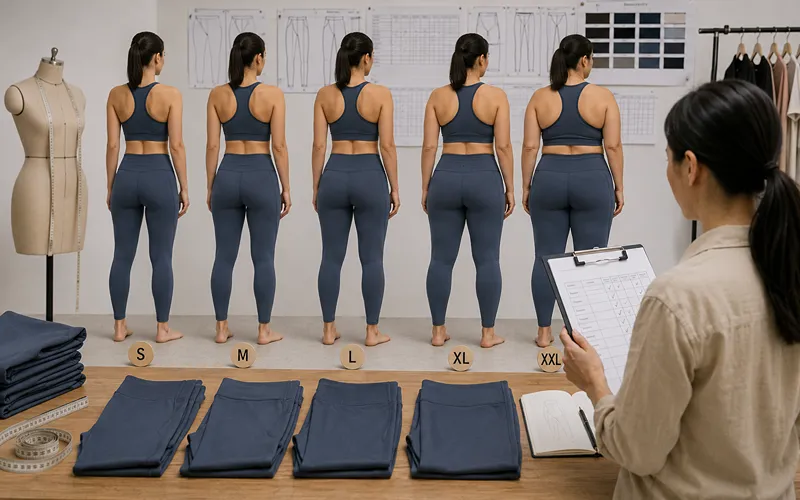
Even when grading happens in the right order, most buyers only try on one size, the sample size, and assume the rest follows correctly.
That’s the gap. Grading is math on paper. It doesn’t show how the garment actually sits on a body two or three sizes away from the sample.
From our own QC log: one order’s sample M passed with zero issues. When we sewed and fit-tested the full size set, the XXL crotch depth was off by almost 2 cm, enough to change how the garment sat. The pattern math looked fine. The real garment didn’t.
Our standard: orders over 500 units per style get a sewn size set (minimum S, M, L, XL), fit-tested on real bodies, not just measured on paper. Smaller runs can use a jumping set (S, L, XXL), but never just one size. Cutting doesn’t start until the size set is signed off.
Mistake #7: Confusing Grading Problems With Production Tolerance
Buyers sometimes catch a garment running small or large, and the factory calls it “within tolerance.” Sometimes that’s true. Sometimes it’s covering up a grading mistake.
Production tolerance is small, expected variation from cutting and sewing. Most factories work within 0.5 to 1 cm at the chest and waist, and 0.3 cm at the sleeve. That’s normal, even for us.
A grading error is different. It’s a fixed problem built into the pattern. It repeats the same way in every unit of that size, every time.
Quality checks are usually built to catch random defects, not this kind of problem. Standards like ANSI/ASQ Z1.4 guide factories to inspect a sample of a shipment rather than every unit. That works for catching stitching or trim issues. It’s not built to catch a grading error, since a grading error affects a whole size run the same way, not just a few random pieces.
How to tell them apart: measure 3 to 4 units of the same size. If the numbers scatter randomly around the spec, that’s tolerance. If they’re all off the same amount in the same direction, that’s a grading error.
What Should You Send Your Sportswear Manufacturer Before Grading?
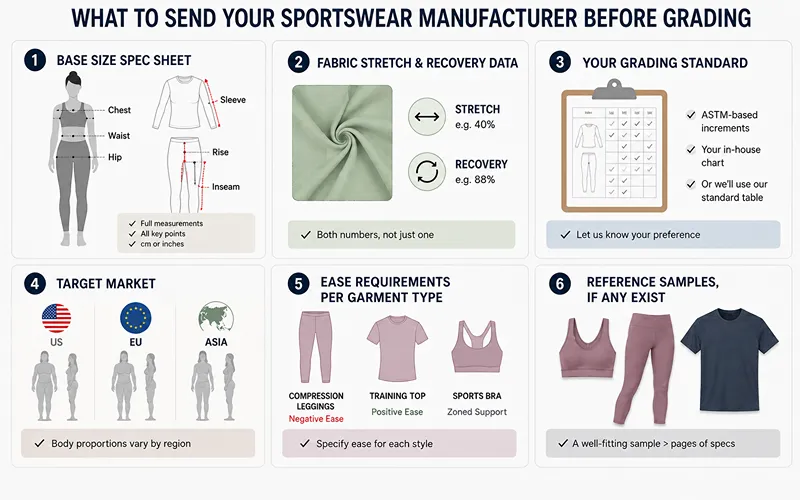
We’ve had buyers send us a size chart and nothing else, expecting perfect grading. It doesn’t work that way. Grading is only as good as what we’re given to work with.
Here’s what we actually need on our end, before any grading starts:
- A base size spec sheet. Not just S, M, L labels. Full measurements at every point: chest, waist, hip, sleeve, inseam, rise. In cm or inches, either works, just be consistent.
- Fabric stretch and recovery data. Both numbers, not just one. A legging fabric with 40% stretch and 88% recovery grades differently than one with 40% stretch and 96% recovery.
- Your grading standard, if you have a preference. Some buyers use ASTM-based increments. Some use their own in-house chart from a previous factory. Tell us which, or we’ll default to our standard table, and that may not match what you shipped before.
- Target market. US, EU, and Asian body proportions are not the same. This changes waist-to-hip ratios more than most buyers expect.
- Ease requirements per garment type. Compression leggings need negative ease. A loose training top needs positive ease. If you don’t specify, we’ll guess based on the tech pack, and guessing is where mismatches start.
- Reference samples, if any exist. A well-fitting garment from a past order tells us more in five minutes than three pages of written specs.
The more of this you send upfront, the fewer sample rounds you’ll need later. A complete package on round one usually means we’re grading correctly by round two, not round four.
Not sure if your grading package is complete? Share your specs with our team before you move into sampling.