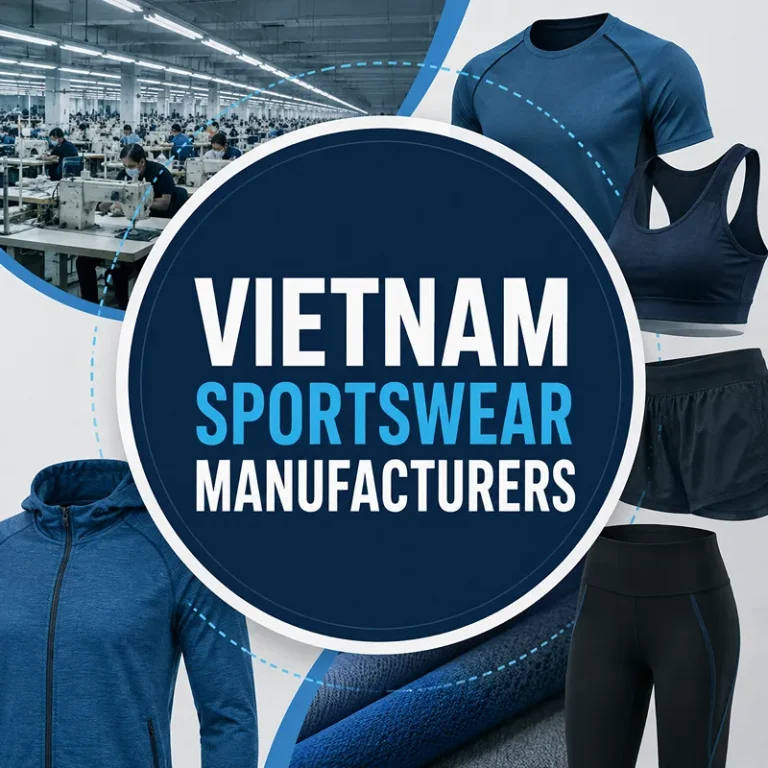
Sportswear Manufacturers in Vietnam at a Glance
Manufacturer | Best Known For | Order Fit | Key Strength |
Thygesen Textile | Scaled activewear production | Established brands & large orders | 3,000 pcs/design MOQ; up to 800,000 pcs/month |
ICM Factory Direct | Low-MOQ custom sportswear | New brands & product testing | MOQ from 72 units; 4-week standard production |
TLD Apparel | Development & material sourcing | Technical activewear collections | In-house development + sourcing across Vietnam, China & Taiwan |
Dar Lon Garment | Technical sportswear construction | Performance & outdoor apparel | Laser cutting, bonding, flatlock & 3D pattern tools |
iGreen Tex Vietnam | Structured OEM development | Brands with ready specifications | 2-step sampling; 7–14 day sample lead time |
Thai Son S.P | Fabric development & control | Fabric-sensitive sportswear | In-house knitting/dyeing; 5–7 day lab dips |
Gold Garment | In-house garment finishing | Decorated & finished apparel | Washing & embroidery capacity around 200,000 pcs/month |
Game Day Manufacturing | Sublimated teamwear | Sports teams, brands & distributors | 4–6 week custom production; some projects from 10 working days |
Dacotex Group | Pattern & fit development | More complex sportswear designs | Gerber/Lectra/Optitex pattern development |
Maxport Limited | Performance sportswear | Technical activewear programs | Performance development + bonded construction |
Suggested Reading:
- 10 Italian Sportswear Manufacturer for Quality Activewear Production
- Top 10 China Leggings Manufacturers: A B2B Sourcing Guide
10 Sportswear Manufacturers in Vietnam
Not every sportswear factory is suited to the same type of order. Below, we focus on the differences that matter when you are actually choosing a production partner.
1. Thygesen Textile — Best for Scaled Activewear Orders
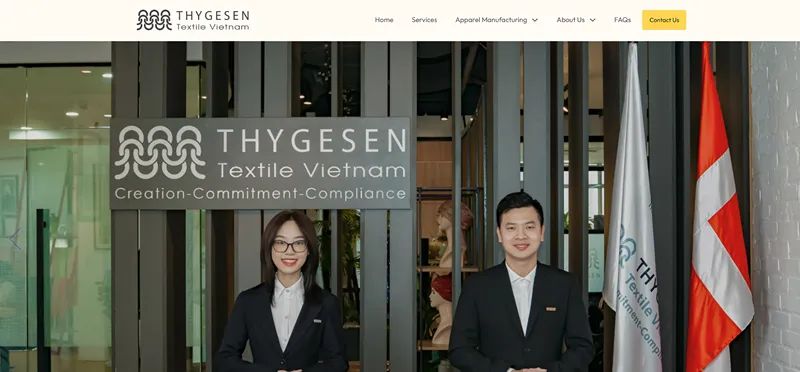
Thygesen is better suited to brands ready for larger production runs. Its standard activewear MOQ is 3,000 pieces per design, with at least 1,000 pieces per color. Standard lead time is around 10–12 weeks, including fabric production.
Its QC process is another point we would check when shortlisting the factory. Thygesen states that it conducts 100% end-line inspection and uses AQL 2.5 for final inspection. Third-party inspections are also accepted.
The factory lists OEKO-TEX® STANDARD 100 among its certifications. This standard covers harmful-substance testing from textile components to finished products.
📌Our take: The 3,000-piece MOQ makes Thygesen less practical for brands testing new SKUs. For established programs, its defined QC process is a stronger reason to shortlist it. Before ordering, we would confirm the color split and fabric MOQ, as both can raise the actual order quantity.
2. ICM Factory Direct — Flexible MOQ for Smaller Orders
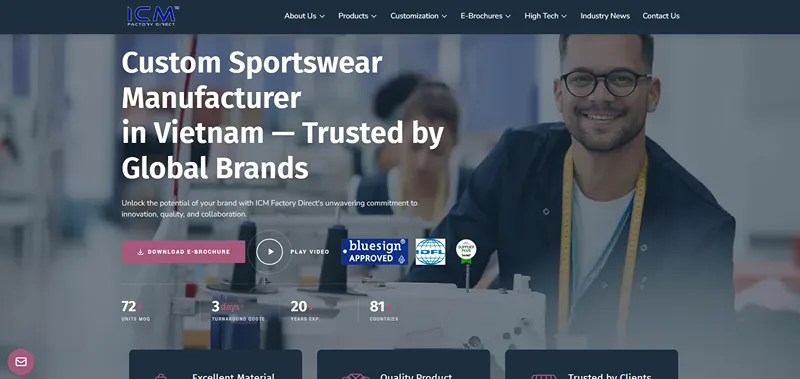
The number that caught our attention is 72 units per style. That is unusually accessible for a custom sportswear order. It gives you room to test a new legging or training-wear SKU before committing to deeper inventory.
But we would not judge the offer on MOQ alone. Ask how those 72 pieces can be divided by color and size, and whether custom-dyed fabric has a separate minimum. ICM states a standard production time of about four weeks after sample approval, so the sampling rounds should also be added to your launch schedule.
There is another detail worth checking if you choose its recycled polyester options. Ask for the GRS Transaction Certificate (TC) tied to the material shipment. The Global Recycled Standard uses chain-of-custody requirements to trace certified recycled material through the supply chain.
3. TLD Apparel — Strong Development and Sourcing Support
TLD keeps several development steps in-house, including design, pattern making, and sampling. Buyers can move from a tech pack to proto and fit samples before bulk production.
Its material network also extends across Vietnam, China, and Taiwan. Options include high-compression nylon, Cordura, Outlast, and Tactel. This gives technical sportswear projects more sourcing choices when local fabrics cannot meet the required performance. We cover more of these differences in our China vs Vietnam activewear manufacturing comparison.
Production is spread across 15+ factories and workshops, with a stated combined capacity of more than 500,000 pieces per month.
For us, the useful combination is clear: in-house development + regional fabric sourcing + access to larger production capacity. For a technical style, we would still approve the fabric and fit before discussing how quickly the order can scale.
4. Dar Lon Garment — Built for More Technical Construction
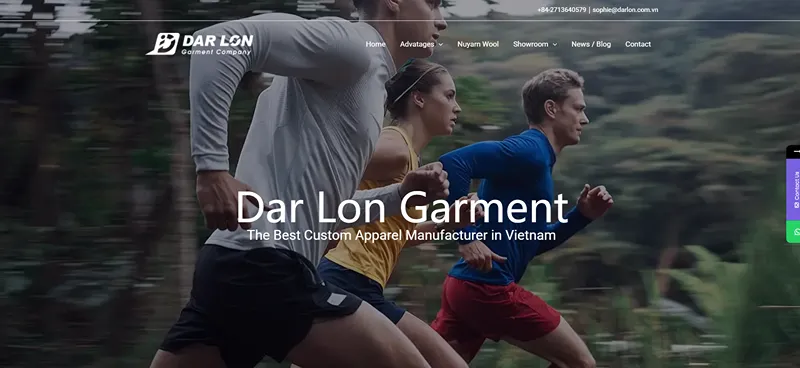
The equipment list is what makes Dar Lon interesting to us. Beyond standard sewing, the factory shows laser cutting, bonding and heat-transfer equipment, flatlock machines, automatic cutting, and 3D pattern tools.
That combination matters when a design includes bonded edges, clean-cut ventilation details, or flat seams. These features need more control than basic cut-and-sew production.
We also noticed its work with Nuyarn performance wool. This opens another direction beyond common polyester-spandex activewear, especially for base layers and outdoor performance pieces.
If we were evaluating Dar Lon for a technical style, we would send the most difficult construction detail first. A successful sample of that detail tells us far more than a long equipment list.
5. iGreen Tex Vietnam — Better When Your Specs Are Already Clear
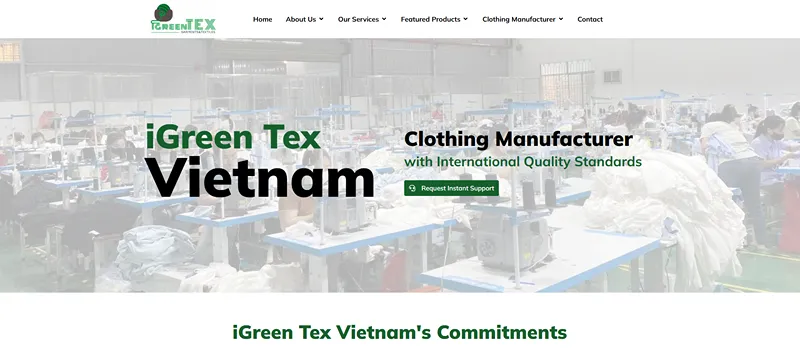
One thing we noticed is how much iGreen Tex relies on buyer-provided specifications. It works mainly on an OEM basis, so a tech pack, detailed specifications, or a physical reference sample is expected. Product photos alone are not enough for accurate development.
Measurements should be defined before sampling, including where and how each point is measured. ASTM D5585, for example, provides standardized terminology for apparel body measurements. Clear measurement references leave less room for different interpretations between your designer and the factory.
There is also a practical cost to get right early. iGreen Tex states that its sampling process takes around 7–14 days and follows a two-step sampling process. The sample fee is refunded after bulk production is confirmed.
We would therefore send the measurement chart, fabric specs, construction details, and artwork together before the first sample. A complete first brief can reduce unnecessary revisions and development delays.
6. Thai Son S.P — More Control Before Fabric Reaches the Sewing Line
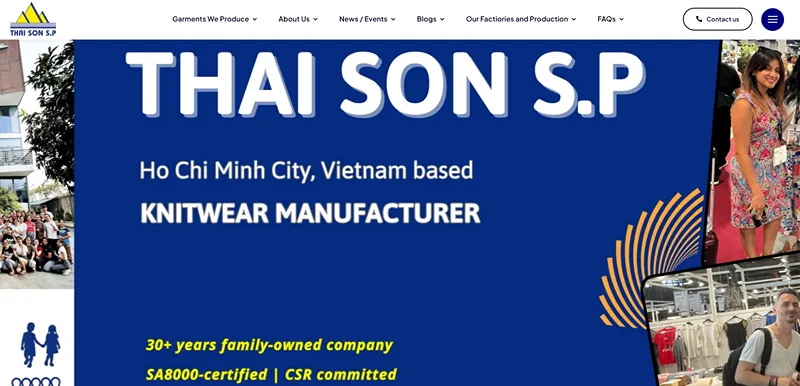
Thai Son S.P handles more of the process before garment assembly. It sources yarns such as cotton, polyester, viscose, and spandex, then manages knitting and dyeing in Vietnam before the fabric moves into production.
For sportswear buyers, the useful part is the extra control over fabric development. Thai Son reports a 5–7 day lead time for lab dips. This gives you a clear checkpoint to approve color before bulk fabric is dyed.
We would use that stage for more than color approval. Ask the factory to confirm the finished GSM, composition, width, and stretch performance at the same time. These details can change after dyeing and finishing.
Catching a fabric issue here is much easier than discovering it after hundreds of garments have already been cut.
7. Gold Garment — More Finishing Work Kept In-House
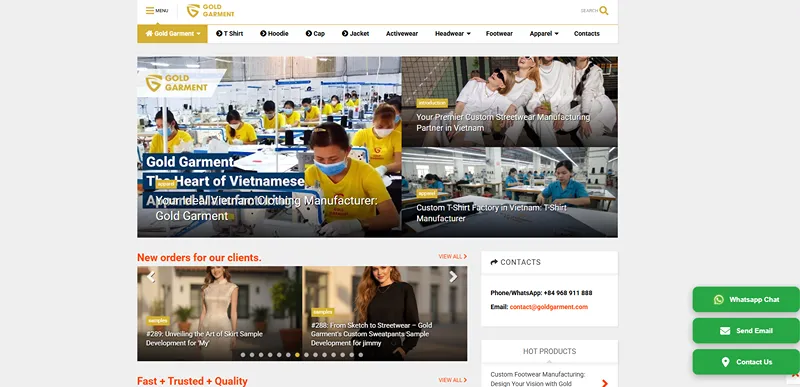
Gold Garment reports in-house washing and embroidery capacity of around 200,000 pieces per month. Its stated total garment capacity is much larger, at about 3 million pieces per month.
The gap between those two numbers is what we would pay attention to. If an order needs heavy embroidery or garment washing, the finishing capacity may matter more than the total sewing capacity.
Keeping these processes in-house can also reduce handoffs between separate suppliers. For embroidered sportswear, we would still approve the placement, stitch density, backing, and finished appearance on the pre-production sample.
Before booking a large decorated order, ask how much of the embroidery or washing will actually stay in-house. That answer gives you a better picture of the real production flow behind your order.
8. Game Day Manufacturing — Built Around Teamwear Deadlines
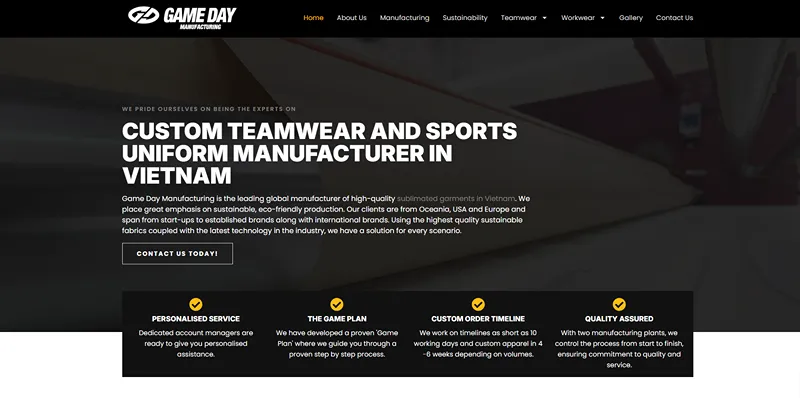
For teamwear, a late order can miss an entire season. That is why Game Day’s published timeline caught our attention. It states a standard custom apparel lead time of around 4–6 weeks, with some timelines as short as 10 working days.
Its production is strongly focused on sublimated sports uniforms. This includes AFL, soccer, rugby, cricket, basketball, and other teamwear. Sublimation also allows multiple colors, player numbers, sponsor graphics, and complex artwork to be built into the same printed design.
We would treat the 10-day figure as a project-specific target, not a default promise. Before confirming a launch date, ask what that timeline includes. Artwork approval, sample approval, fabric availability, and order volume can all affect the final delivery date.
9. Dacotex Group — Look at the Pattern Room, Not Just the Sewing Floor
What gives us more confidence in Dacotex is its pattern-development setup. Its technical pattern makers are expected to work with Gerber, Lectra, or Optitex. Their work covers pattern creation, fit corrections, size grading, and follow-up from sampling to finished production.
That matters for sportswear with shaped panels, fitted sleeves, curved seams, or complex size grading. These details can fail even when the sewing quality looks clean.
If we were testing Dacotex, we would send one approved reference size first. Then we would compare the first sample against the POM measurements, balance, seam position, and movement during fitting.
10. Maxport Limited — Stronger for Performance Sportswear
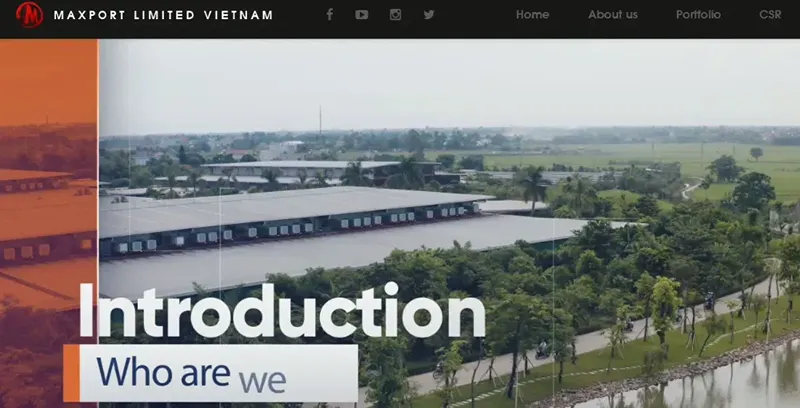
Maxport is more relevant when a sportswear collection needs more than basic cut-and-sew production. Its development work covers performance garments where fit, stretch, lightweight construction, and movement need to work together.
One capability we would pay attention to is bonded construction. In sportswear, bonding can reduce bulky seams in areas such as waistbands, hems, pockets, and lightweight jacket panels. Maxport has also worked with bonding specialist Bemis through an R&D design lab.
For buyers, the benefit is not the technology itself. It is the ability to develop cleaner and lighter sportswear without relying on traditional stitching everywhere. Before sampling, we would ask to see one recent sportswear example using the same construction method. This helps confirm that the capability is being used in real production, not just available in the R&D room.
How to Shortlist a Vietnam Sportswear Manufacturer
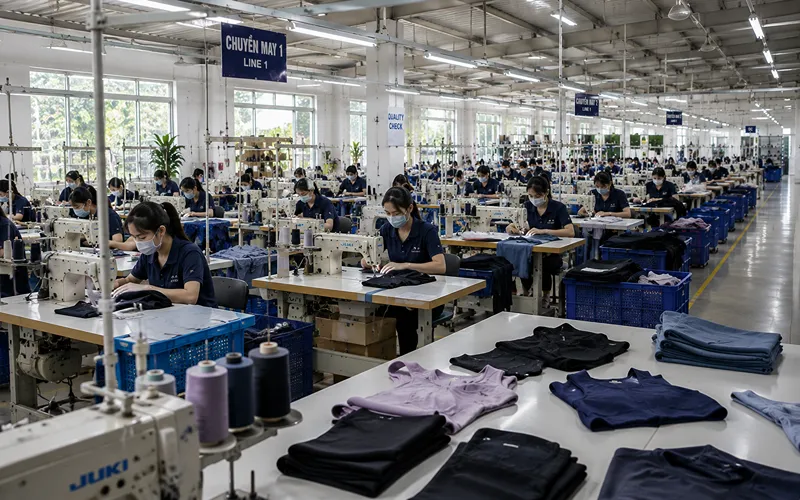
Do not shortlist a factory from its product list alone. We use four checks before deciding whether a sportswear supplier is worth sampling.