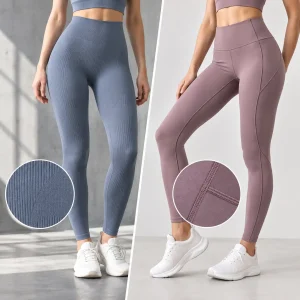

What Is a Sportswear Tech Pack?

A sportswear tech pack is a technical file. It tells a factory exactly how to build your garment. Not a sketch. Not a mood board. A real set of instructions.
Think of it like a recipe. Except instead of ingredients and steps, it covers things like:
- Flat drawings — front and back views of the garment
- Fabric and trim details — what goes into it, and where it comes from
- Stitch and seam types — how each part gets sewn together
- Exact measurements — for every size, with a tolerance range built in
Sportswear needs its own version of this document. Regular apparel tech packs often skip things like seam bonding (or seamless bonding), mesh panels, or stretch recovery. Sportswear can’t skip those. A four-way stretch legging needs different stitch specs than a cotton tee.
Measurements deserve extra attention here. ASTM International runs a committee dedicated to standardizing body measurements for apparel sizing, so fit stays consistent across brands and garment types. Your tech pack’s size chart is where that standardization gets applied to your product, size by size.
Need help checking your measurements before sampling? Send us your tech pack or size chart. Our team will review the details and help identify possible fit issues early.
What a Complete Tech Pack Should Include
A tech pack isn’t one document. It’s several sections working together. Each one answers a different question a factory needs to know before they cut a single piece of fabric.
Flat sketches
These are the front and back technical drawings of your garment. Not a fashion illustration. No shading, no model, no artistic flair. Just clean black-and-white lines showing seams, panels, and trim placement exactly where they belong.
Most brands create these in Adobe Illustrator, which has become the standard tool for this kind of technical drawing across the industry.
A few things we always tell clients:
- Show both sides. Front only isn’t enough. If the back has a zipper, mesh panel, or seam detail, draw it.
- Add a side or inside view when needed. A jacket with an internal pocket, for example, needs that pocket drawn somewhere. Otherwise our pattern team has to guess where you want it.
- Skip the color and shading. Save that for later. At this stage, we just need to see the construction clearly.
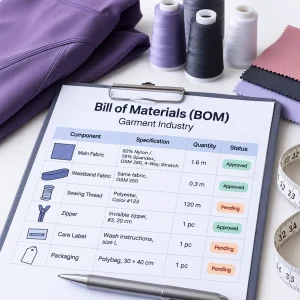
Bill of Materials (BOM)

The BOM is basically a shopping list for your garment. It lists every material that goes into it. Fabric, thread, zippers, elastic, labels, all of it. Nothing gets left off. If it’s not on the BOM, the factory won’t source it.
Here’s what a solid BOM usually includes:
- Fabric details — composition, weight (GSM), and color
- Trims — zippers, drawcords, elastic, reflective tape, whatever your design needs
- Labels and tags — main label, size label, care label, hang tag
- Thread type and color — yes, this matters for durability too
- Supplier or reference source, if you already have one you like
We always tell clients this. The more specific you are, the more accurate your leggings manufacturing cost estimate will be. “Stretch fabric” tells us almost nothing. Understanding sportswear fabric selection helps us determine what to price and source accurately like “88% polyester, 12% spandex, 220 GSM, four-way stretch” .
We once got a BOM that just said “zipper, black.” No size. No brand. No pull type. We had to go back and forth with the client three times before sampling could even start. Once we got the specs down to the millimeter, the next version of that same garment took one round, not four.
Size specification sheet
This is the chart that keeps every size consistent. It lists exact measurements, point by point, for each size in your range. Chest width, waist, inseam, sleeve length. Whatever matters for your garment.
Each measurement gets a tolerance too. That’s the small amount of variation the factory is allowed. Without a tolerance, cutters and sewers have no idea how tight “exact” needs to be.
A good size spec sheet usually has:
- Point of measure (POM) list — the exact spots on the garment to measure, like “chest, 2.5cm below armhole”
- Measurements per size — every size you’re producing, laid out size by size
- Tolerance range — how much variation is acceptable per measurement
- Grading rules — how much each measurement changes from one size to the next
Leggings Size Chart Example (Unit: cm)
POM Code | Measurement Point | Tolerance (±) | S | M | L | XL |
A | Waistband width (relaxed, flat) | 1.0 | 33 | 36 | 39 | 42 |
B | Waistband height | 0.5 | 20 | 21 | 22 | 23 |
C | Hip width (below waistband, 5cm down) | 1.0 | 46 | 49 | 52 | 55 |
D | Front rise | 0.6 | 28 | 29 | 30 | 31 |
E | Back rise | 0.6 | 34 | 35 | 36 | 37 |
F | Inseam length | 1.0 | 68 | 69 | 70 | 71 |
G | Thigh width (2.5cm below crotch) | 0.8 | 30 | 32 | 34 | 36 |
H | Leg opening width | 0.5 | 15 | 16 | 17 | 18 |
I | Outseam length (waist to hem) | 1.0 | 96 | 98 | 100 | 102 |
Construction and workmanship notes

Sportswear needs way more construction detail than regular clothing. The wrong seam type means chafing, blowouts, or a garment that can’t handle real movement during quality inspection.
What to specify:
- Seam type — flatlock, overlock, bonded, or coverstitch
- Stitch density — stitches per inch (SPI) at stress points
- Bonding specs — tape width and heat-press temperature
- Mesh placement — exact panel locations, in cm from a fixed point
- Reinforcement — bar tack stitch count at strain points
A few numbers we actually work with on the floor:
- Flatlock seams on leggings and base layers, typically 8-10 SPI. Lies flat against skin, low chafe risk, but weaker than a bonded seam under heavy load.
- Bonded seams on running jackets and compression wear, usually a 5mm tape width at 140-160°C press temperature. No needle holes, keeps water out — but we need the tape type and temperature written down, or we’re guessing.
- Crotch seam on leggings needs a higher stitch count than most buyers expect. We typically run 12-14 SPI there, since a loose seam blows out fast under stretch.
- Bar tacks at strap ends or pocket corners, usually 10-16 stitches per tack, depending on fabric weight.
Not sure if your construction details are production-ready? Get a professional review from LuckPanther before sampling. Our team can help evaluate seam types, stitch requirements, and reinforcement details for your sportswear designs.
Color and print/embroidery details
Color and decoration need exact specs too, not just a reference photo. A slightly wrong Pantone code or a print placed 2cm off can mean a rejected sample.
What to include:
- Pantone (TPX) codes — for every color in the garment, not just the main body. Trim, drawcords, and even thread should have their own code. “Navy blue” can mean five different shades to five different dye houses.
- Print method — screen print, DTF, dye sublimation, or heat transfer. Each one behaves differently on stretch fabric, so the method needs to match your fabric blend, not just your design.
- Print placement — measured in cm from a fixed point, like the collar seam, center front, or hem. “Centered on the chest” isn’t a measurement. “8cm below shoulder seam, centered” is.
- Print size — exact width and height in cm, down to the decimal if the design is small. A logo spec’d at 6cm wide can print noticeably larger or smaller if the size isn’t locked in.
- Embroidery specs — stitch count (usually 4,000-8,000 for a small chest logo), thread color code, and backing type (cut-away, tear-away, or no-show mesh). Backing type especially matters on thin or stretch fabric, since the wrong one can leave the logo area stiff or puckered after a few washes. Experienced sportswear manufacturers in China usually review these details during sampling to make sure decoration methods match the fabric and garment construction.
Packaging and labeling requirements

This section covers what happens after the garment leaves the sewing line. Skip it, and you risk products arriving unlabeled or non-compliant for your market.
What to spec out:
- Hang tag placement and content — brand name, size, price if applicable
- Poly bag specs — bag size and thickness
- Carton labeling — style number, size breakdown, quantity per carton, barcode placement
- Folding method — flat fold, hanger-ready, or roll-packed
- Care label content — wash instructions, fiber content, country of origin
Care labels aren’t optional if you’re selling in the US. The FTC’s Care Labeling Rule requires permanent, legible care instructions sewn or heat-sealed into the garment. A removable hang tag doesn’t count.
Common Sportswear Tech Pack Mistakes That Delay Production

We see the same handful of mistakes over and over. Here’s what actually slows down sampling on our floor. These issues are especially common when launching private label activewear collections for the first time.
Only a sample size measurement
Brands fill in just the medium column and write “grade normally.” But grading rules vary by 1-2cm per size jump depending on brand and region. We’ve paused cutting to ask what logic to use, which can add a week to the timeline.
Vague material specs
“Moisture-wicking polyester” with no GSM or blend ratio leaves us guessing. We once picked 180 GSM for a client who actually wanted 220 GSM. The sample came back too thin, and that round could’ve been skipped with two more numbers on the BOM.
No stitch count at stress points
“Reinforce the seams” isn’t a spec. Without a number, we default to 8-10 SPI standard construction, when a crotch seam or underarm on high-movement pieces often needs 12-14 SPI to hold up.
Front-view sketch only
A back zipper or mesh panel that only exists in someone’s head doesn’t make it into the garment. We’ve had full re-cuts happen over one missing back view.
Mid-sampling changes never logged
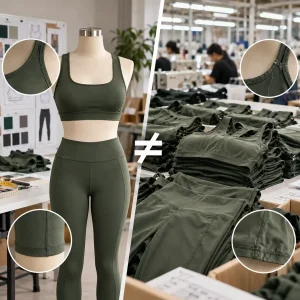
A tweak gets emailed over, we make it, and the tech pack file never gets updated. Bulk production then references the old version, and the mismatch surfaces after cutting, not before.