
What Is GSM in Textiles?
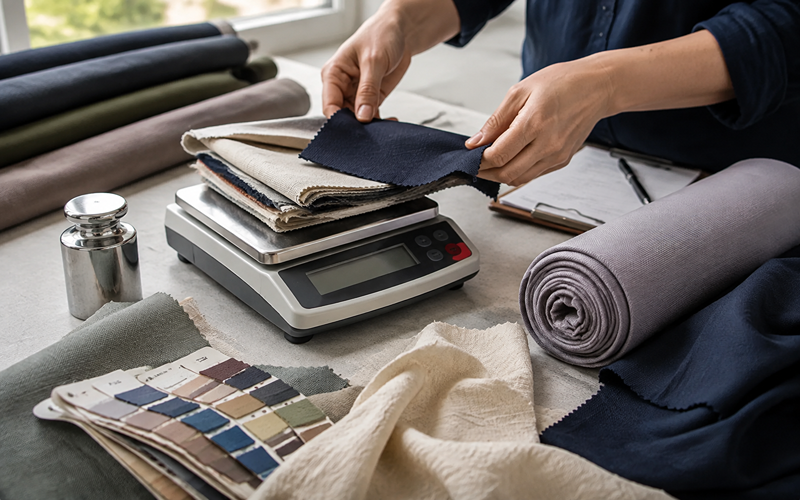
GSM stands for grams per square meter. It measures how heavy a fabric is.
- Higher GSM = thicker fabric
- Lower GSM = lighter fabric
But GSM isn’t just a random number on a spec sheet. It’s tested using a real method. The global benchmark is ASTM D3776/D3776M, a standard test method used across the textile industry to measure fabric weight in grams per square meter or ounces per square yard.
How we handle it at our factory
We don’t just trust the GSM number a yarn supplier gives us. We weigh a sample of every fabric roll ourselves before it ships. This one step catches most weight mismatches before they ever reach you.
GSM vs. OZ/YD²: know the conversion
Some U.S. suppliers still quote fabric weight in ounces per square yard, not GSM. This causes confusion during sourcing calls.
Here’s the quick math: GSM = OZ/YD² × 33.9
So a fabric quoted at 6 oz/yd² comes out to roughly 203 GSM. Keep this formula handy. It saves you from comparing two suppliers who are actually quoting the same fabric weight in different units.
Higher GSM ≠ better quality
This is a common myth. Higher GSM just means heavier, not better made. A well-finished 180 GSM polyester fabric can actually outperform a poorly made 220 GSM modal fabric blend if the finishing and knit structure are done right. Weight is only part of the story.
GSM Ranges Explained: Light, Medium, Heavy
Fabric weight breaks down into three simple buckets. Buyers who master these three ranges, under 150, 150 to 300, and over 300 GSM, avoid most ordering surprises.
Here’s how we sort it on our production floor.
Light: Under 150 GSM
This range feels thin and breathable. It works great for summer wear.
- Basic t-shirts
- Tank tops
- Lightweight linings
We use light polyester fabric here often. It keeps garments cool and easy to move in.
Medium: 150 to 300 GSM
This is the workhorse range. Most everyday apparel lands here.
- Premium t-shirts
- Custom leggings
- Polo shirts
- Mid-weight joggers
Most of our leggings orders fall between 180 and 240 GSM. This gives enough stretch recovery without feeling see-through. It’s a range we test constantly, because a few grams off can change how the leggings squat-test.
Heavy: Over 300 GSM
This range means structure and warmth.
- Hoodies
- Outerwear
- Heavy-duty workwear
We rarely go above 400 GSM unless a client specifically wants a boxy, structured feel. Past that point, comfort usually drops fast.
⭐One thing we tell every new client
Don’t just pick a GSM because a competitor’s product page lists it. Match the number to how the garment will actually be worn. Fabric weight testing itself follows a formal international standard, ISO 3801, which sets the method mills use to measure mass per unit area consistently across the industry. That’s the same discipline we apply to every roll before it ships. If you need support choosing the right fabric specifications for your activewear products, feel free to contact LuckPanther for professional guidance from fabric selection to production.
How to Choose the Right GSM for Sportswear
Same GSM doesn’t mean same performance. This is the part most guides skip. It’s also where buyers get burned most often.
GSM alone doesn’t tell you about stretch
Two fabrics can both weigh 220 GSM. But they can behave completely differently. One might be a four-way stretch knit. The other might barely stretch at all.
Stretch and recovery get tested separately from weight. The standard test for this is ASTM D4964. It measures elongation, tensile strength, and elastic recovery in fabrics with spandex or other elastic yarns. We ask for this data alongside GSM whenever a client sources leggings or compression wear.
✅ Always request both numbers. GSM tells you weight. Stretch data tells you fit.
Climate should shift your GSM too
A summer training top and a fall training top might serve the same purpose. But they shouldn’t share the same GSM. We usually drop 20 to 30 GSM for warm-climate orders. This keeps airflow high. The garment style stays exactly the same.
Blended fabrics can trick a basic weight check
Polyester-spandex blends don’t always weigh evenly across a roll. Nylon-spandex blends have the same issue. Spandex content can shift slightly between batches, even when the base fiber ratio stays the same.
This is where some Chinese sportswear manufacturers cut corners. They report GSM based on the polyester fabric alone. Then they skip re-testing after the elastane is added. We test the finished blend instead, not just the base yarn. That’s the only way to get an honest number.
The most common rework request we get
Buyers rarely come back asking for a different GSM. They usually come back asking about recovery after wash testing. A legging can hit the right GSM and still bag out at the knees. This can happen after just ten washes. That’s a stretch recovery issue, not a weight issue.
We now run a five-wash recovery check before every bulk approval. This one step has prevented more reorders than any GSM adjustment ever has.
Quick GSM Reference Table for Sportswear
Bookmark this table. It’s the fastest way to check your spec before you send it to production.
Product Type | Recommended GSM | Why |
Base layers / compression wear | 130–180 GSM | Light, stretchy, sits close to skin |
Running & training tops | 150–200 GSM | Breathable, holds shape after washing |
Custom leggings & performance bottoms | 180–240 GSM | Balances opacity and stretch |
Team uniforms & heavy-duty gear | 220–300 GSM | Withstands repeated wear and abrasion |
Outerwear / winter sportswear | 300 GSM and up | Adds warmth and structure |
A few quick notes before you use this table:
- These are working ranges, not fixed rules. Your fabric blend and finish can shift the ideal number.
- Always confirm the GSM tolerance with your supplier, not just the target number.
- For stretch fabrics like leggings, ask for recovery data too. GSM alone won’t tell you how the fabric holds up after wash.
If a supplier’s quote falls outside these ranges, that’s not automatically wrong. But it’s worth asking why.
GSM vs Fabric Thickness: Are They the Same?
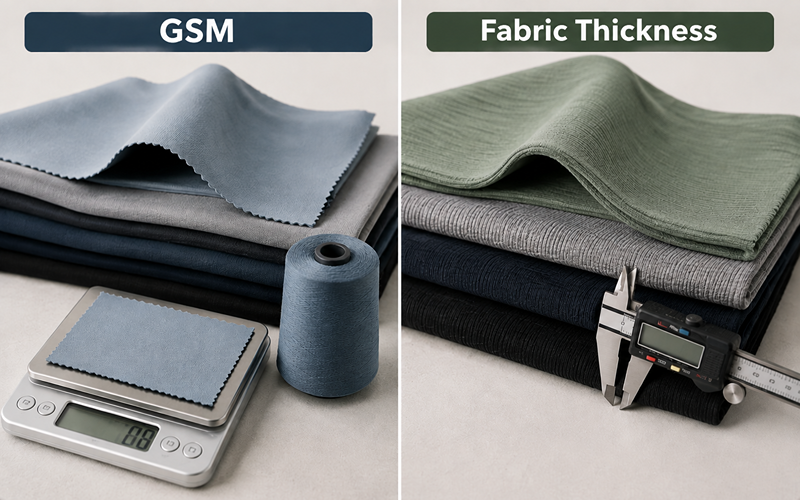
No, they’re not the same thing. This mix-up trips up a lot of buyers.
GSM | Thickness | |
What it measures | Weight per square meter | Distance from top to bottom of the fabric |
Unit | Grams (g/m²) | Millimeters (mm) |
Test method | ASTM D3776 | |
What drives it | Fiber density and yarn weight | Knit or weave structure, loft |
Can be misleading when | Fabric is tightly knit but feels thin | Fabric is loosely knit but feels thick |
Why the two don’t always match
It comes down to density. A tightly knit fabric packs more fiber into less space. It weighs more without feeling any thicker.
A loosely knit fabric works the other way. It can feel thick and fluffy but weigh less on the scale.
We’ve tested 200 GSM fabrics that felt thinner than some 160 GSM fabrics. Knit structure made the difference, not the weight number.
What this means for your sourcing
Don’t assume a lower GSM means a thinner fabric, or the other way around. Ask for both numbers before you approve a sample.
At our facility, we test GSM and thickness on every new fabric, not just one or the other. A good China leggings manufacturer should hand you both figures without you having to ask twice.
This is one of the small checks we build into every order at Luckpanther. If you’re sourcing sportswear and want a supplier who tests this properly from the start, we’re happy to walk you through our process.